







Blue Bulletin
Majors Industries
March 2026

CATS price trends
CATS price trends in the secondary market
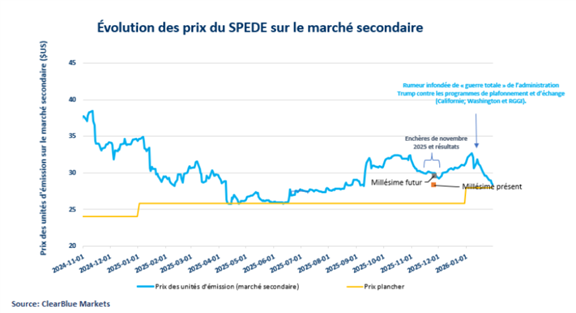
In the last quarter of 2025, secondary market prices remained stable at around US$30/tonne of CO2, despite a brief peak above US$32 following the announcement that the California program, now called Cap-and-Invest, would be extended until 2045. However, the lack of regulatory details fuelled uncertainty, contributing to a November 2025 auction that closed below secondary market prices, at US$28.32 (CAD$39.64) for the current vintage. For reference, the 2025 auction floor price was US$25.87, and the 2026 floor price has been set at US$27.94.
The year 2026 began with a gradual price recovery, temporarily disrupted by unfounded rumours of potential federal action targeting the country’s cap-and-trade programs. Once these rumours subsided, the market stabilized between US$30 and US$31. At the same time, the CARB regulatory process resumed on January 13, 2026, with the publication of the Initial Statement of Reasons (ISOR), an explanatory document released prior to the official version of the proposed regulation.
As of February 2, 2026, the price of an emission allowance stands at US$28.38, or US$0.44 above the current floor price.
Assessment of CATS operating parameters:
Status report
The anticipated full regulatory publication was released in late January 2026. It confirmed several structural adjustments to the California program. These changes strengthen the emissions reduction trajectory, notably through the removal of 118.3 million allowances between 2027 and 2030 and more than one billion by 2045. The application of the “offset under the cap” rule starting in 2027 will require the removal of an equivalent number of allowances for each offset credit used. Other proposals concern allocation rules for natural gas and electricity distributors and tighter conditions for access to the allowance reserve, as well as a shift to shorter compliance periods starting in 2027, followed by alternating two- and three-year compliance periods beginning in 2030. The official public comment period, open January 23, will continue until March 9, 2026, ahead of a planned adoption vote on May 28, 2026.
In Quebec, the publication of the regulation amending the Regulation respecting a cap-and-trade system for greenhouse gas emission allowances is still pending but remains expected in winter 2026. The key parameter is the removal of about 17 million allowances. This publication is occurring in a rapidly evolving political context: the resignation of François Legault has triggered a leadership race within the CAQ, while the government has postponed its target date for reducing emissions to 37.5% below 1990 levels to 2035, (link in French only) signalling a shift toward economic considerations at the expense of climate ambition. The direction of this file will depend on the political orientations that emerge ahead of the fall 2026 election.
At the same time, a connection with the State of Washington remains plausible in the 2027–2028 timeframe, as California plans to apply its new cap trajectory starting January 1, 2027, and exchanges between Washington, California and Quebec have intensified in recent weeks. Such integration, combined with the allowance reductions planned in California and possibly in Quebec, could generate significant upward pressure on prices in the medium term. However, the absence of an official timeline continues to create uncertainty regarding the pace of development of a potentially expanded market.
February 18, 2026 auction: First auction of the year
The first auction of 2026 was on February 18, 2026. A total of 54.9 million current vintage allowances and 6.5 million advance vintage allowances was offered. The 2026 minimum auction price was set at US$27.94.
The results was released on February 25, 2026 (in French only)