







Blue Bulletin
Majors Industries
March 2026

CO2 management: a high-potential value chain for heavy industry
Following our previous discussion on carbon dioxide (CO2) capture, this article examines the next stages of the CO2 value chain—transport, utilization and storage—and their potential for certain industry sectors.
CCUS: A Driver of Decarbonization and Economic Growth
Carbon capture, utilization and storage, or CCUS, is expected to play an increasingly important role in the decarbonization of heavy industry, particularly in sectors where production processes require very high temperatures or involve high emissions intensity, such as cement, steel, fertilizers and petroleum refining.
For companies in these sectors, CCUS offers particularly attractive environmental and economic prospects, while also providing competitive and reputational advantages. The value of CCUS is increasingly recognized around the world and in Canada, where several large-scale projects have been launched in recent years, including the Alberta Carbon Trunk Line (ACTL) and Quest CCS project in Western Canada, and the Deep Sky project in Bécancour, Quebec. The Canada Energy Regulator also points to growth in this sector, projecting that Canadian heavy industry will capture a total of 6 Mt of GHG emissions through CCUS in 2030 and up to 24 Mt in 2040.1
Environmental benefits: sequestration in support of decarbonization
The environmental benefits of CCUS are the most evident, as it enables companies to actively reduce their carbon footprint by capturing the CO2 they generate, which can then be sequestered (stored) or used for commercial purposes.
There are two main methods for sequestering captured CO2:
geological sequestration, in the Earth’s crust:
Geological sequestration involves injecting CO2 either into underground natural reservoirs, such as depleted oil and gas fields, mature oil reservoirs, or unmineable coal seams, or into saline aquifers, which are reservoirs of non-potable salt water located deep beneath the sea. Current estimates suggest that Canada’s subsurface could theoretically store the country’s annual CO2 emissions (708 million tonnes in 2022) for hundreds of years.2 In Quebec, a research project led by INRS is underway to assess the geological CO2 storage capacity of the St. Lawrence Lowlands.
solid sequestration, in materials such as concrete:
Solid CO2 sequestration generally occurs through carbonation, a chemical reaction that stores this gas in stable carbonates—solid materials, in other words. This sequestration method is currently used by companies including Carbicrete in Quebec and CarbonCure in Nova Scotia to produce low-carbon or carbon-neutral concrete. This method is still relatively undeveloped, but it may nevertheless have considerable potential. For reference, researchers at the Swiss Federal Laboratories for Materials Science and Technology (Empa) estimate that concrete could store 5 to 10 billion tonnes of CO2 per year, enough to sequester all excess CO2 within 100 years.3
Other promising methods
Other promising methods are also being studied, including CO2 sequestration in mining residues, biochar (a material produced by the pyrolysis of biomass), as well as in organic-rich shales or porous basalt formations beneath the ocean floor. Such methods have yet to be validated at large scale, however.
Economic benefits: financial support and market development
CCUS also offers economic value for companies in Quebec thanks to various incentives and the voluntary carbon market, as well as current and potential commercial opportunities arising from the storage and utilization of CO2.
- The federal government’s CCUS investment tax credit (ITC) is a refundable tax credit, ranging from 37.5% to 60%, applicable to expenditures incurred for the purchase of equipment used to capture, transport, store or utilize CO2 as part of an eligible CCUS project.
- Through its Project Acceleration initiative, the Canada Infrastructure Bank provides financing for energy transition projects, including CCUS projects.
- The Canada Growth Fund, with a total value of $15 billion, invests in energy transition projects and supports the CCUS market in particular through the issuance of contracts for difference, which help guarantee the carbon price.
- In Quebec, the cap-and-trade system for greenhouse gas emissions (CATS) is a regulated carbon market that governs the sale of carbon offsets (carbon credits) obtained through CO2 capture, storage or recovery. Companies that exceed their regulatory obligations by reducing their emissions below their benchmark intensity continue to receive offset credits, which they can sell to companies seeking to compensate for unavoidable GHG emissions in order to reduce their carbon market compliance costs.
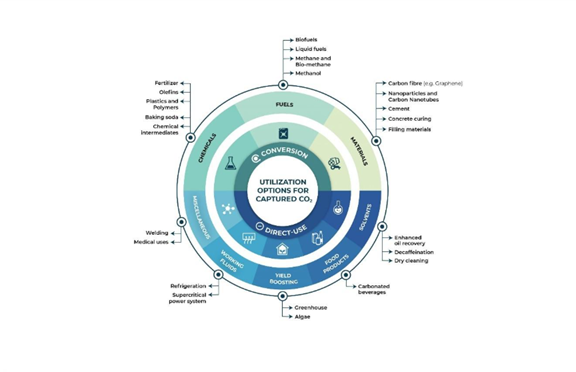
- CO2 can be used in a variety of ways, including water treatment, the production of carbonated beverages, pharmaceuticals and refrigerants, as well as dry ice for fire extinguishers. It is also used to produce certain fertilizers, polycarbonates, polyurethanes and low-carbon concrete, as mentioned above.
- CO2 could be used to produce sustainable synthetic fuels for freight transport and aviation, high-value molecules for the cosmetics, pharmaceutical and animal nutrition industries, or third-generation renewable natural gas (RNG) through CO2 methanation. Énergir is particularly interested in the opportunities offered by this technology as part of the development of its RNG sector.
- The development of regional or even cross-border CO2 storage hubs could also present commercial potential, as noted by Natural Resources Canada in Canada’s Carbon Management Strategy.
CO2 transport:
a key component of CCUS
Serving as the link between capture and storage or utilization, CO2 transport is a crucial step in the CCUS value chain.

Pipelines are currently the most common means of transporting CO2. Together, the United States and Canada have nearly 10,000 km of pipelines with a transport capacity of about 225 Mt per year, a figure expected to increase with the planned construction of approximately 7,000 km of additional pipelines by 2027.4 In pipelines, CO2 is generally transported in a supercritical state, meaning at a pressure above 74 bar (1,073 psi) and a temperature above 31 °C. Depending on the distance, this type of transport may require intermediate recompression.

Although still under development, marine transport represents a cost-effective alternative to pipelines over long distances (more than 350 km for offshore storage and 1,100 km for coast-to-coast transport). In this case, LNG carriers equipped with pressurized tanks at 15 bar (217.5 psi) and -30 °C are used. However, because the density of CO2 is nearly two and a half times greater than that of methane, large quantities of CO2 can be transported in smaller tanks. This could encourage the construction of smaller, less energy-intensive vessels, as is the case for the Northern Lights project in Norway.

Rail transport is also an attractive option in countries with extensive electrified rail networks, such as France and Germany, due to its low carbon intensity.
Competitive and reputational advantages
By participating in one or more stages of the CUSC value chain, companies can also improve their competitiveness and brand image.
Indeed, reducing CO2 emissions not only helps companies meet their own decarbonization targets, it also contributes to government energy transition objectives, such as those set by the Government of Quebec in its 2030 Plan for a Green Economy.
In addition, using CO2 to manufacture low-carbon products (such as concrete, synthetic fuels and plastics) can represent a competitive advantage because of their environmental sustainability—an attribute that is increasingly sought after in Canada and many other countries.
Finally, like any decarbonization initiative, CCUS and its components provide companies with an excellent way to concretely improve their environmental performance as part of an ESG approach, thereby enhancing or strengthening their reputation with customers, investors and other stakeholders, as well as with the public.
A key strategy for decarbonizing the economy
Although carbon management comes with several challenges—particularly in terms of regulation, financial support, technical and economic feasibility, and social acceptability—it remains an essential component of the measures to reduce GHG emissions outlined in Canada’s 2030 Emissions Reduction Plan.5 At the international level, CCUS is also recognized as essential by the Intergovernmental Panel on Climate Change (IPCC)6 and the International Energy Agency (IEA)7 to achieve net-zero emissions.
Challenges and opportunities
There is therefore strong momentum for the implementation of CCUS projects among companies seeking to reduce their carbon footprint or benefit from a rapidly expanding sector in Canada and worldwide. For example, the Pembina Institute estimates that the market for CO2-based products alone could reach US$1 trillion by 2030.8 In addition, Quebec and Canada have all the assets necessary to become leaders in carbon management thanks to recognized expertise, geology well suited to CO2 storage and world-class innovators. However, as a recent report on CO2 management notes, “the success of these initiatives will depend […] not only on advances in research and innovation, but also on international cooperation, political commitment and the active participation of civil society”9.
Énergir can support your CCUS projects
To learn more about Énergir’s expertise in carbon management, obtain technical support for a CCUS project, or simply discuss the potential of CCUS in the context of your commercial or industrial activities, contact your Énergir Major Industries advisor.