







Although annual maintenance is not mandatory under current regulations, the Régie du bâtiment du Québec (RBQ) strongly recommends annual maintenance of natural gas heating systems and water heaters for safety reasons, including reducing the risk of carbon monoxide exposure. Properly maintained equipment also consumes less energy, which can lead to savings on your bills.
On this page, you’ll find details on maintenance you can do yourself and annual inspections to plan for according to your natural gas system.
Are you a business customer? Find maintenance tips tailored to your needs.
General advice
- The natural gas flame should be blue. Avoid using an equipment with a yellow or orange flame (other than a fireplace) or that is unstable
- Maintain the appliance's air intake and exhaust vents, making sure that nothing is blocking the ventilation or the exhaust of combustion gases.
- The exterior natural gas installations (connection, meter, air intake and exhaust pipe) must be accessible at all times. The connection must therefore be kept clear of any snow or ice accumulation. This situation could lead to the interruption of the natural gas supply or a substandard appliance performance.
- Have your heating system or water heater inspected annually by a qualified contractor who is licenced by the Régie du bâtiment du Québec (RBQ) and belongs to the Corporation des maîtres mécaniciens en tuyauterie du Québec (CMMTQ).
Maintenance tips
Preventive maintenance is essential for ensuring the proper operation, longevity and energy efficiency of your natural gas equipment. Below, discover the checks you can carry out yourself and those that should be handled by a qualified professional, depending on your system.
How do you identify your natural gas heating system?
A hot-water heating system includes radiators.
A warm-air heating system includes ducts and vents in floors or ceilings.

Boiler

warm-air furnace
Check your boiler before or during each heating season to ensure optimal performance :
- Make sure your boiler is set to the minimum temperature required for the heat distribution system and meets your needs and final uses.
- Check pumps and valves to detect any water leak.
- Look for boiler wall and hot water distribution pipe hot points that identify insulation gaps. Remember, if it's too hot to handle, you're losing heat.
- Purge the air out of the radiators by leaving the faucet open until water starts coming out. Clean the radiator fins regularly for increased efficiency.
Maintenance to be performed by a qualified contractor :
- Annual maintenance includes water and air level checks, combustion chamber maintenance, water drainage (if necessary), conduit leak checks, combustion efficiency measurements, etc.
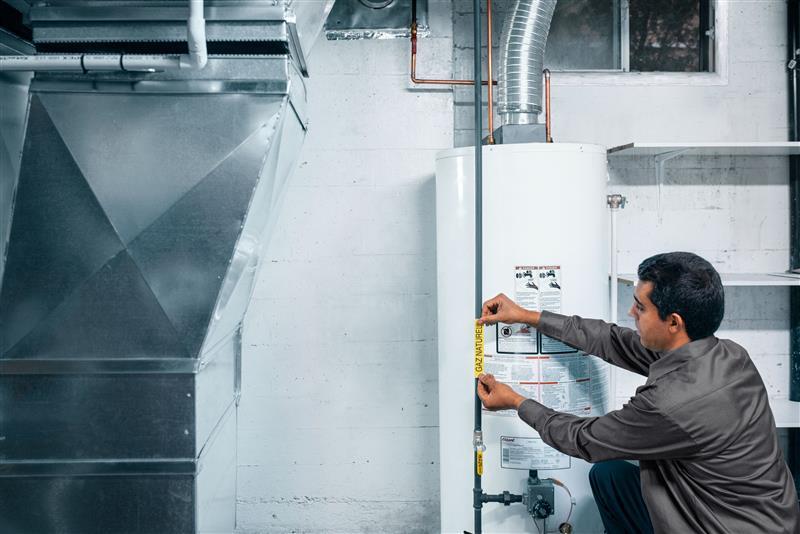
You can do some checks on your warm-air furnace to maintain performance:
- Remove any obstacles in ducts, registers and cold air return registers so that the air can circulate freely throughout the network.
- Clean the air filter of the warm air furnace regularly during heating season in order to ensure optimal air circulation.
Maintenance to be performed by a qualified contractor:
- Have the exhaust shaft (chimney) checked occasionally from the inside and from the outside, to detect any signs of deterioration due to condensation or corrosion. If you have a high performance condensing system, make sure the technician checks the gas exhaust pipe to ensure it follows an upright slope and the end is not obstructed.
Boiler
Check your boiler before or during each heating season to ensure optimal performance :
- Make sure your boiler is set to the minimum temperature required for the heat distribution system and meets your needs and final uses.
- Check pumps and valves to detect any water leak.
- Look for boiler wall and hot water distribution pipe hot points that identify insulation gaps. Remember, if it's too hot to handle, you're losing heat.
- Purge the air out of the radiators by leaving the faucet open until water starts coming out. Clean the radiator fins regularly for increased efficiency.
Maintenance to be performed by a qualified contractor :
- Annual maintenance includes water and air level checks, combustion chamber maintenance, water drainage (if necessary), conduit leak checks, combustion efficiency measurements, etc.
warm-air furnace
You can do some checks on your warm-air furnace to maintain performance:
- Remove any obstacles in ducts, registers and cold air return registers so that the air can circulate freely throughout the network.
- Clean the air filter of the warm air furnace regularly during heating season in order to ensure optimal air circulation.
Maintenance to be performed by a qualified contractor:
- Have the exhaust shaft (chimney) checked occasionally from the inside and from the outside, to detect any signs of deterioration due to condensation or corrosion. If you have a high performance condensing system, make sure the technician checks the gas exhaust pipe to ensure it follows an upright slope and the end is not obstructed.

Warm-air furnace + heat pump combo

Natural gas boiler + electric boiler combo
You can do some regular maintenance on your dual-energy heating system to maintain performance.
- Clean the system filter at least each season or per the manufacturer’s instructions. During the heating season, clean it regularly to maintain airflow.
- Remove obstructions from ducts, warm-air vents and cold-air return vents to allow free airflow throughout the system.
- Ensure the outdoor heat pump unit remains clear of debris such as leaves or snow.
Annual maintenance
- Schedule a full system inspection with a qualified contractor, including coils, condensation drain and refrigerant levels.
Electric boilers require maintenance similar to natural gas boilers.
Perform checks before or during each heating season to ensure optimal performance:
- Set boilers to the minimum required temperature for your heat distribution system and needs.
- Check pumps and valves for water leaks.
- Look for “hot spots” on boiler walls or hot-water pipes to identify insulation issues. Remember that if it’s too hot to touch, it means there’s significant heat loss.
- Maintain your radiators. Bleed the air from each radiator by leaving the valve open until water starts to flow. Also, clean the radiator fins regularly for greater efficiency.
Have a qualified professional perform annual maintenance :
- Electrical components are maintained differently from the combustion chamber. The same heating professional (who is licensed by the RBQ and belongs to the CMMTQ) can maintain an electric boiler, provided no electrical connections are required. Electrical connections must be carried out by a master electrician who is a member of the Corporation des maîtres électriciens du Québec (CMEQ).
Warm-air furnace + heat pump combo
You can do some regular maintenance on your dual-energy heating system to maintain performance.
- Clean the system filter at least each season or per the manufacturer’s instructions. During the heating season, clean it regularly to maintain airflow.
- Remove obstructions from ducts, warm-air vents and cold-air return vents to allow free airflow throughout the system.
- Ensure the outdoor heat pump unit remains clear of debris such as leaves or snow.
Annual maintenance
- Schedule a full system inspection with a qualified contractor, including coils, condensation drain and refrigerant levels.
Natural gas boiler + electric boiler combo
Electric boilers require maintenance similar to natural gas boilers.
Perform checks before or during each heating season to ensure optimal performance:
- Set boilers to the minimum required temperature for your heat distribution system and needs.
- Check pumps and valves for water leaks.
- Look for “hot spots” on boiler walls or hot-water pipes to identify insulation issues. Remember that if it’s too hot to touch, it means there’s significant heat loss.
- Maintain your radiators. Bleed the air from each radiator by leaving the valve open until water starts to flow. Also, clean the radiator fins regularly for greater efficiency.
Have a qualified professional perform annual maintenance :
- Electrical components are maintained differently from the combustion chamber. The same heating professional (who is licensed by the RBQ and belongs to the CMMTQ) can maintain an electric boiler, provided no electrical connections are required. Electrical connections must be carried out by a master electrician who is a member of the Corporation des maîtres électriciens du Québec (CMEQ).
Water heater
Air ducts
Maintenance tasks you can do yourself:
- Regularly visually inspect your water heater for leaks and check that the drain pipes are not blocked.
- Insulate your hot water pipes, especially those that run through unheated areas, with urethane or fibreglass tubes to reduce heat loss.
Maintenance to be performed by a qualified contractor :
- Repair leaky water faucets and install aerators.
- Drain water heaters with a tank once a year. This will eliminate deposits at the bottom of the tank and save you replacement and repair as well as energy consumption costs.
- Maximize the performance and energy efficiency of your heating and air conditioning equipment by following the recommendation to have your ventilation ducts cleaned at least every three years. Effective duct cleaning can counteract several factors related to inadequate ventilation. In addition to requiring repeated maintenance of components, dust accumulation can, among other things, lead to significant heat loss, clog filtration systems, decrease the mechanical performance of your unit, and reduce its lifespan due to overheating of the heat exchanger.
- Cleaning ducts vastly improves air quality for occupants. A thorough cleaning removes contaminants such as dust, allergens, bacteria, mould, germs and more.
Water heater
Maintenance tasks you can do yourself:
- Regularly visually inspect your water heater for leaks and check that the drain pipes are not blocked.
- Insulate your hot water pipes, especially those that run through unheated areas, with urethane or fibreglass tubes to reduce heat loss.
Maintenance to be performed by a qualified contractor :
- Repair leaky water faucets and install aerators.
- Drain water heaters with a tank once a year. This will eliminate deposits at the bottom of the tank and save you replacement and repair as well as energy consumption costs.
Air ducts
- Maximize the performance and energy efficiency of your heating and air conditioning equipment by following the recommendation to have your ventilation ducts cleaned at least every three years. Effective duct cleaning can counteract several factors related to inadequate ventilation. In addition to requiring repeated maintenance of components, dust accumulation can, among other things, lead to significant heat loss, clog filtration systems, decrease the mechanical performance of your unit, and reduce its lifespan due to overheating of the heat exchanger.
- Cleaning ducts vastly improves air quality for occupants. A thorough cleaning removes contaminants such as dust, allergens, bacteria, mould, germs and more.
Trust the Énergir Partner network
Call on an Énergir Partner for the maintenance of your equipment. Énergir Partners are certified contractors in heating, plumbing, ventilation, air conditioning and refrigeration who are licensed by the RBQ and belong to the CMMTQ. They provide professional, reliable and high-quality service.
Has your heating equipment been in service for several years?
Now may be a good time to replace it with a dual-energy electricity-natural gas system. You could be eligible for grants and see recurring savings on your bill.

© 2004-2026, Énergir. All rights reserved.