







Natural gas market conditions
Seasonal Dynamics
As the summer season progresses, North American gas markets continue to recover from the storage levels strained by the harsh winter of 2025–2026.
In the United States
Inventories rebounded rapidly thanks to record production, allowing inventories to reach 3,020 Bcf in mid-July, about 181 Bcf above the five-year average. Summer injections should make it possible to complete the season around 3,960 Bcf by late October, above historical norms.
In Canada
In Canada, the story is quite similar to that of our neighbours to the south: inventories are also being replenished at a healthy pace, although storage levels remain more balanced than they were last year. National inventories are expected to reach 862 Bcf by late October, a healthy level but approximately 90 Bcf below the record levels observed in 2025. However, Canadian inventories remain approximately 77 Bcf above the five-year average, helping to maintain some downward pressure on summer prices.
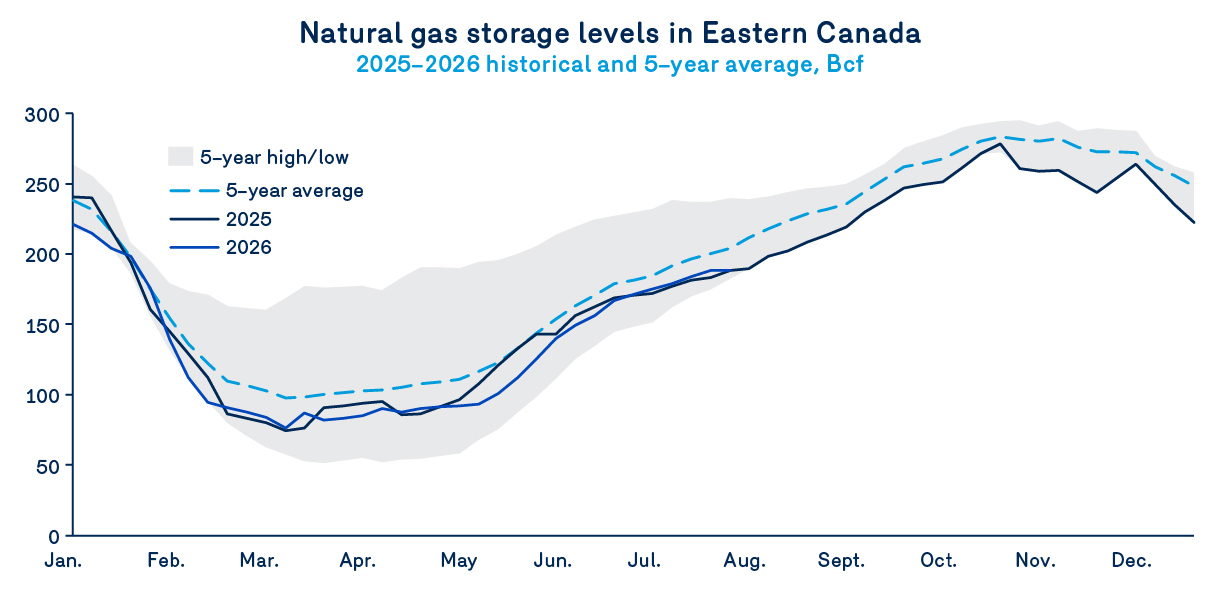
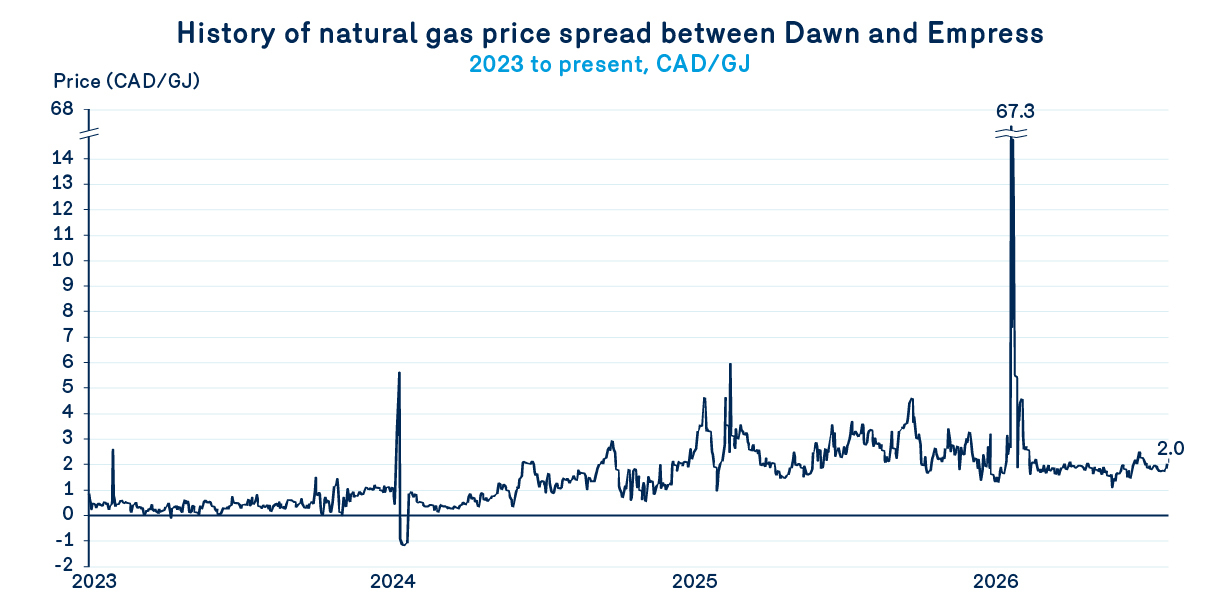
Eastern Canada, which was particularly strained during the late-January 2026 polar vortex, currently has relatively low storage levels, as illustrated in the chart below, but is benefiting from gas transfers from Western Canada to replenish its reserves and is expected to return to a level closer to the five-year average before the start of winter. A favourable price spread between Dawn and Western Canada, fluctuating around $2/GJ, continues to encourage west-to-east gas flows. S&P Global therefore expects robust continental inventories at the start of the heating season, providing a relatively comfortable supply outlook for the coming winter.
Supply-demand balance on the North American market
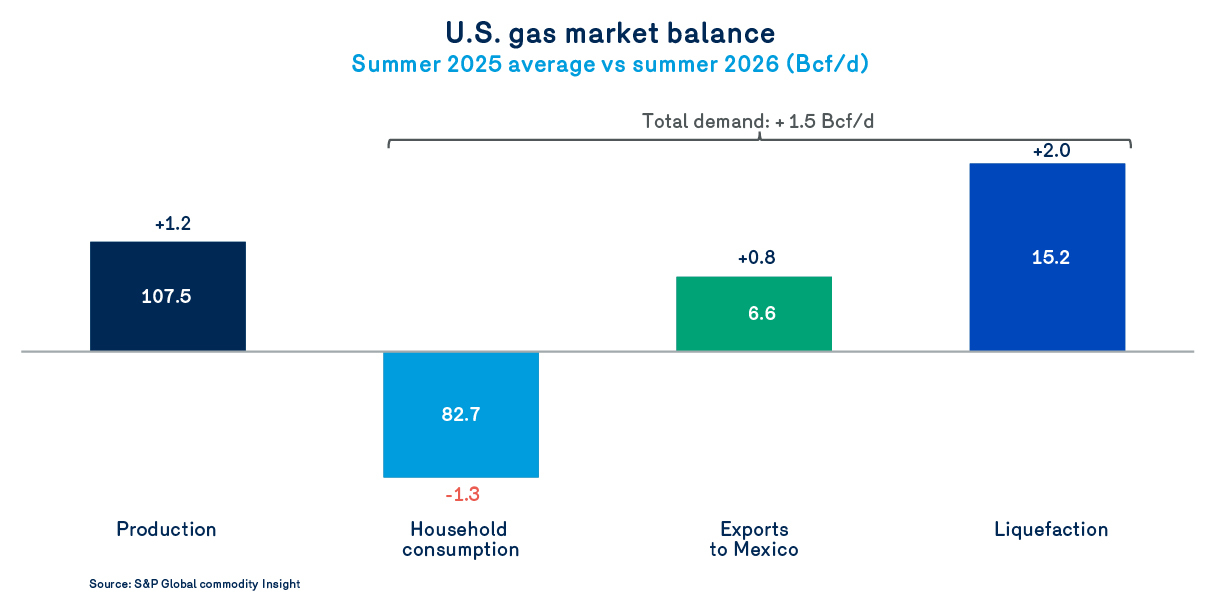
Since 2025, the North American natural gas balance has continued to evolve amid simultaneous growth in both supply and demand. On the demand side, the primary driver of growth remains liquefied natural gas (LNG) exports, although the ramp-up of new capacity has not been as rapid as initially expected. In the United States, a number of liquefaction facilities are continuing to ramp up production, but some projects have experienced start-up delays or more gradual production increases, notably Golden Pass LNG and, more recently, temporary outages at Freeport LNG. Despite these setbacks, gas consumption for LNG exports averaged 15.2 Bcf/d, with record daily levels of approximately 19 Bcf/d during the summer of 2026, more than 2 Bcf/d above the summer of 2025. In Canada, LNG Canada is also continuing to ramp up operations, but reaching full capacity has taken longer than anticipated, pushing part of the demand growth into late 2026.
The emergence of data centres continues to represent a credible source of growth in North American natural gas demand. Although a number of projects remain in the development stage, their initial impacts are already beginning to emerge. According to S&P Global, data centres powered directly by natural gas currently account for 0.2 Bcf/d of demand and could represent nearly 3.7 Bcf/d of U.S. demand by 2031, a significant upward revision from previous forecasts. This growth is particularly concentrated in Texas, near major natural gas production basins, but is also emerging in parts of the Northeast and Midwest. In Canada, demand from data centres is currently negligible, but TransCanada Energy, having recently revised upward its forecasts for North American natural gas demand in the coming years, expects data centres to account for part of this growth. Concentrated in Alberta, where the provincial government is prioritizing projects with their own power-generation systems to avoid overloading the power system, this new source of demand could reach just over 0.5 Bcf/d by 2031. This is in addition to the increase in electricity consumption associated with data centres connected to the grid across the country, which indirectly supports gas demand for power generation.
Across North America, however, natural gas demand from the power sector remains relatively stable. Despite rising cooling and electricity needs, the rapid growth of solar power in the United States—with approximately 33 GW added in 2024, 36 GW in 2025 and another 36 GW expected in 2026—as well as the slowdown in coal plant retirements, is limiting the growth of gas consumption. The combined effects of data-centre growth and the gradual retirement of coal-fired generation capacity should become more apparent toward the end of the decade. As a result, domestic consumption remains stable, and even slightly lower, compared with 2025 levels.
On the supply side, North American production continues to show strong growth. In the United States, production at times exceeded 110 Bcf/d during the summer of 2026, reaching new records, primarily driven by the Permian Basin. This growth is largely fuelled by associated gas from oil production, supported by oil prices that remain high enough to sustain drilling activity. Productivity improvements, higher gas-to-oil ratios and the addition of new pipeline capacity have also helped bring additional volumes to market. In Canada, production is also increasing, driven primarily by the Montney and by growing demand associated with LNG exports.
Price Outlook
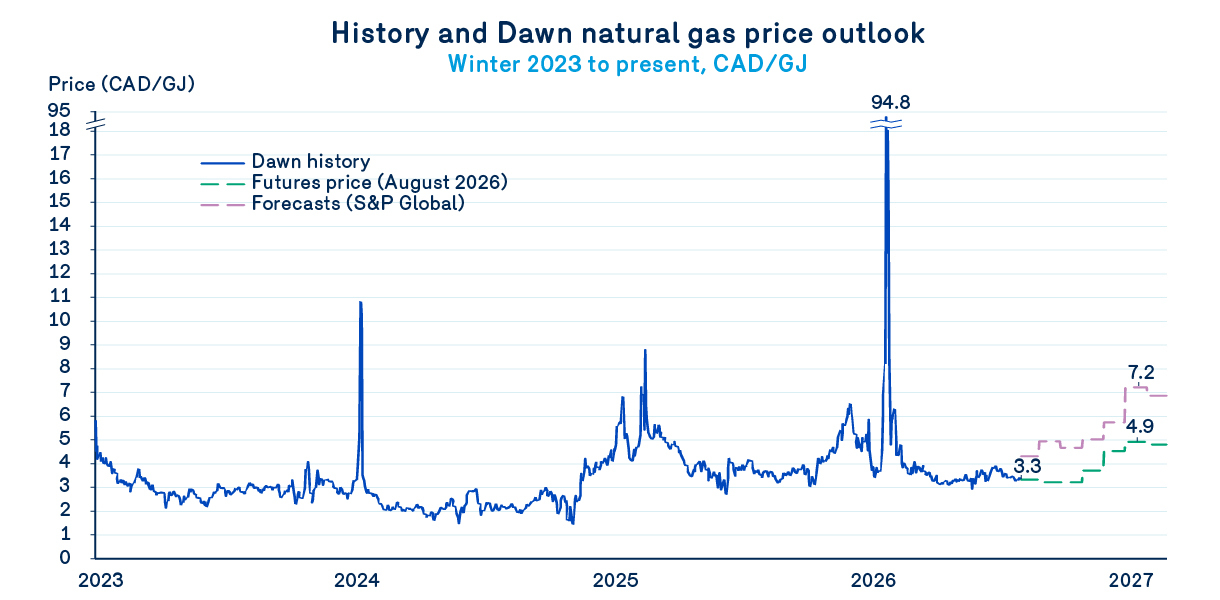
Looking ahead to winter 2026–2027, markets appear to be anticipating a generally more balanced environment than the one that prevailed a year ago. North American demand growth, driven primarily by the ramp-up of LNG exports, is real, but it is being accompanied by comparable growth in supply. In the United States, increased production from the Permian Basin and continued growth in associated gas are limiting the risk of a tightening market in the near term. The industry’s ability to respond quickly to new demand is helping to moderate expectations for higher prices, despite an upward demand outlook.
Current price forecasts therefore point to relatively stable prices compared with recent winters. Markets remain sensitive to winter temperatures, the balance between supply and demand growth, and potential regional supply constraints, particularly in eastern North America. However, in the absence of an exceptionally cold winter, current fundamentals suggest a relatively stable market environment. The latest market data indicated an average price of $4.74/GJ at Dawn for the upcoming winter period, down from the average price of $6.42/GJ recorded during winter 2025–2026, which was weighted by the extreme event that occurred in late January 2026.