








CATS price trends
August 2026 Auction Results
The last auction was held on August 19, 2026 and the results were released on August 26, 2026.
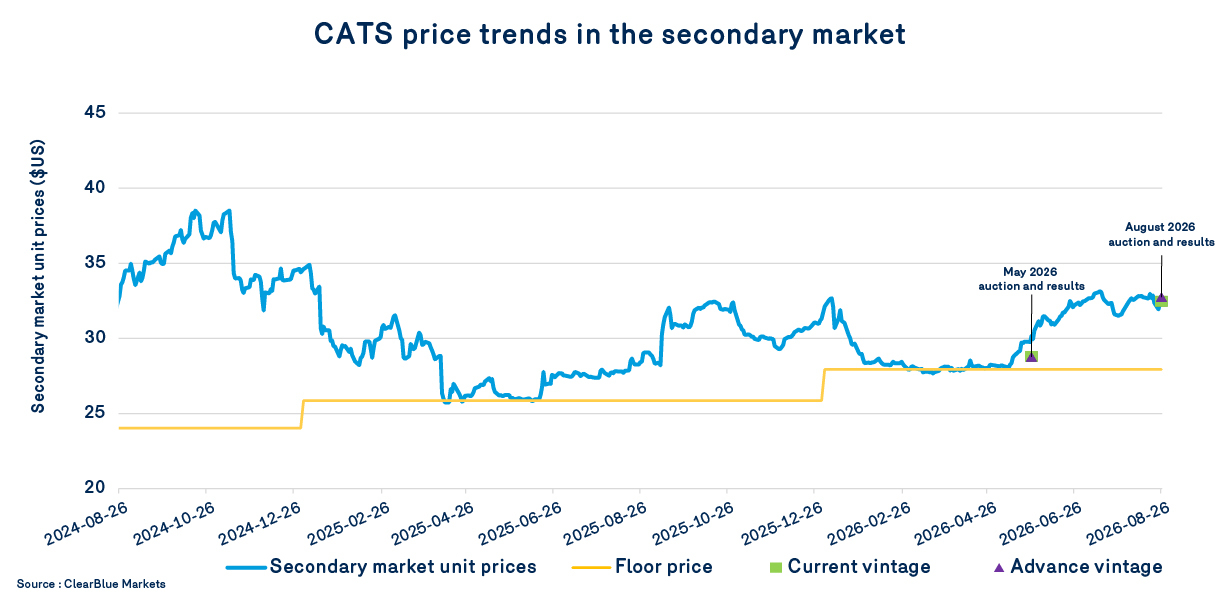
Current vintage units were awarded at US$32.48 (C$45.11) per unit. Future vintage units were sold at US$32.75 (C$45.49) per unit. All offered units found takers.
As a comparison, the current vintage units at the May 2026 auction sold at US$28.81 (C$39.63), while the future vintage units had reached US$28.76 (C$39.57).
Complete auction results are available on the website of the Ministère de l’Environnement, de la Lutte contre les changements climatiques, de la Faune et des Parcs.
Changes in CATS prices over the past three months
On the secondary market, the emission unit price was US$32.29 on the day the August auction results were released, only 0.6% under the auction price. This reflects sustained demand, namely through the reduction in regulatory uncertainty around California’s cap-and-investment program and Quebec’s cap-and-trade system in recent months.
Regulatory Developments
In May, the California Air Resources Board (CARB) took a major step forward by adopting a review of California’s cap-and-trade program. This reform aims to bring the carbon market more in line with the State’s carbon neutrality target by 2045, notably through a gradual and sustained reduction in the supply of emission allowances and the additional removal of units when offset credits are used. The new regulation also introduces a new mechanism: the Manufacturing Decarbonization Incentive (MDI). Following the required regulatory review, the changes were approved by the California Office of Administrative Law (OAL) on August 31, 2026, and then filed with the California Secretary of State. The new provisions come into force on September 1, 2026, in line with the CARB timetable, thus enabling the new provisions to be applied in time for the allocation of the 2027 free allowances planned in October 2026.
In a similar vein, on August 27, 2026, the Quebec government published in the Gazette officielle du Québec the amendments to the CATS regulation that are tightening its market as well. The main changes include the revision of compliance periods, reduction of offset credit use (maximum limit from 8% to 6%) and introduction of requirements on the use of Quebec offset credits (the portion of credits issued by the government department that can be used for compliance will be at least 1% in 2027 and 2% starting in 2029). The Regulations are expected to come into force 15 days after they are enacted.
Finally, in June, an agreement was signed to integrate Washington State into the Quebec and California common market starting in 2027. This linkage could alter the market balance by increasing demand for emission allowances, while prices observed in Washington remain higher than those in the Quebec-California market.
These developments confirm the trend toward a tighter carbon market observed over the past several years. The reduction in the offer of units, reduced access to offset credits and the upcoming integration of Washington could continue to put pressure on compliance costs over the medium and long term.
CU valuation as part of the CFR and impact on GSR price
Following the Régie de l’énergie decision authorizing Énergir to use the Compliance Unit (CU) accounting methodology, Énergir’s teams revised the GSR price calculations by incorporating the value of these CUs into the prices and resubmitted these rates for approval. As a reminder, CUs are transactional tools used to enhance the environmental attributes of GSR (e.g., lower carbon intensity than fossil-based natural gaz, renewable, biogenic) under the federal Clean Fuel Regulations (CFR).
This decision is expected to reduce the GSR supply tariff from $25.04/GJ (94,884 ¢/m³) in 2025-2026 to $22.49/GJ (85,239 ¢/m³) in 2026-2027, a decrease of 10.18%.
Socialization fees would also be lowered to 4.055 ¢/m3 for 2026-2027, compared to 4.800 ¢/m3 in last June’s filing. This decrease is the result of both the forecast component reduction and the unsold GSR reduction.
Subject to Régie de l’énergie approval, these new rates would come into effect on October 1, 2026.