







Express Blue Bulletin
Major Industries
June 2026

New Rates for Fall 2026
The new rates proposed by Énergir were filed with the Régie de l’Énergie on May 14 and are pending approval, with an application date of October 1, 2026.
Learn more about our price changes in each section.
Pricing of Énergir’s Services
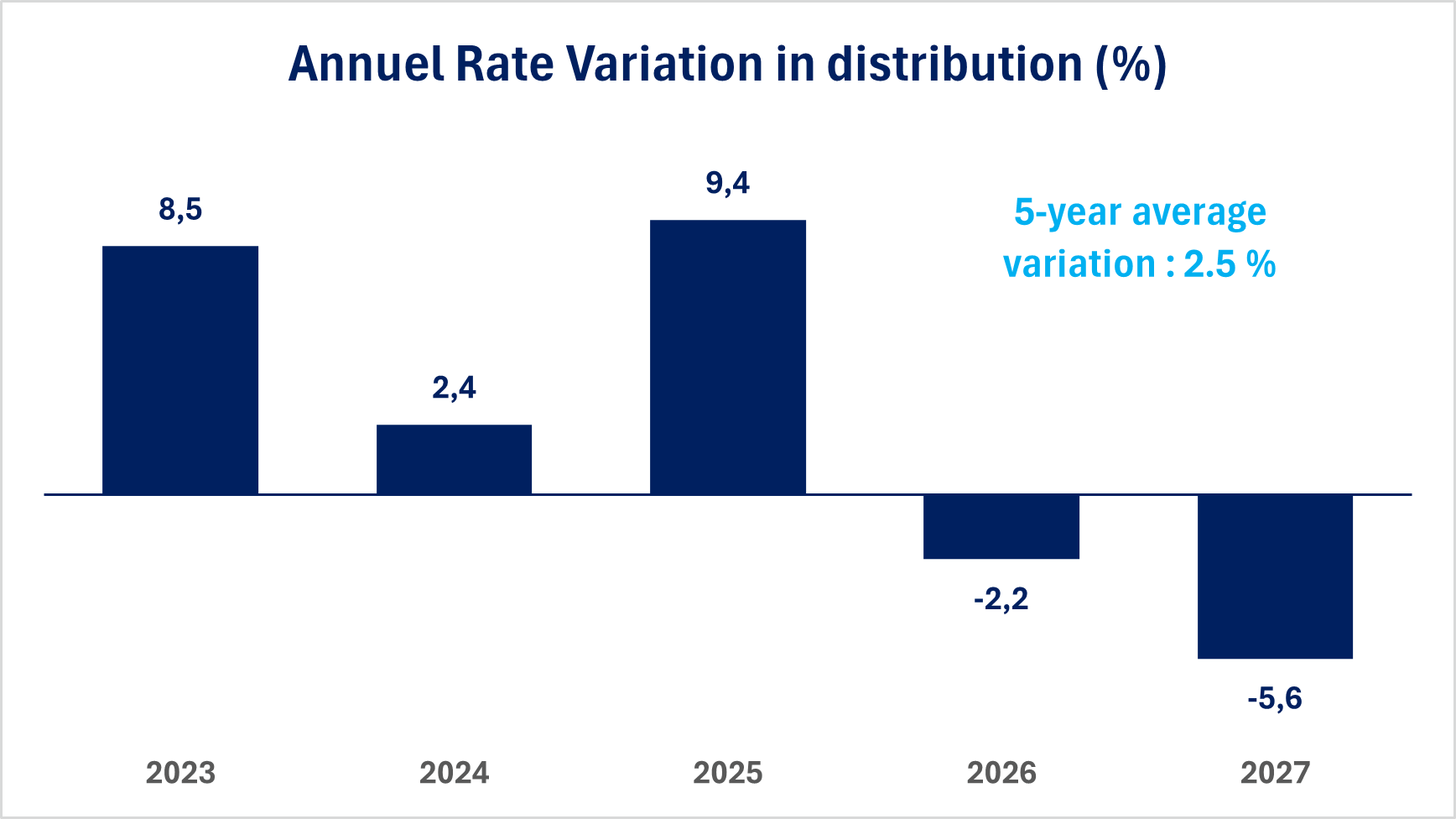
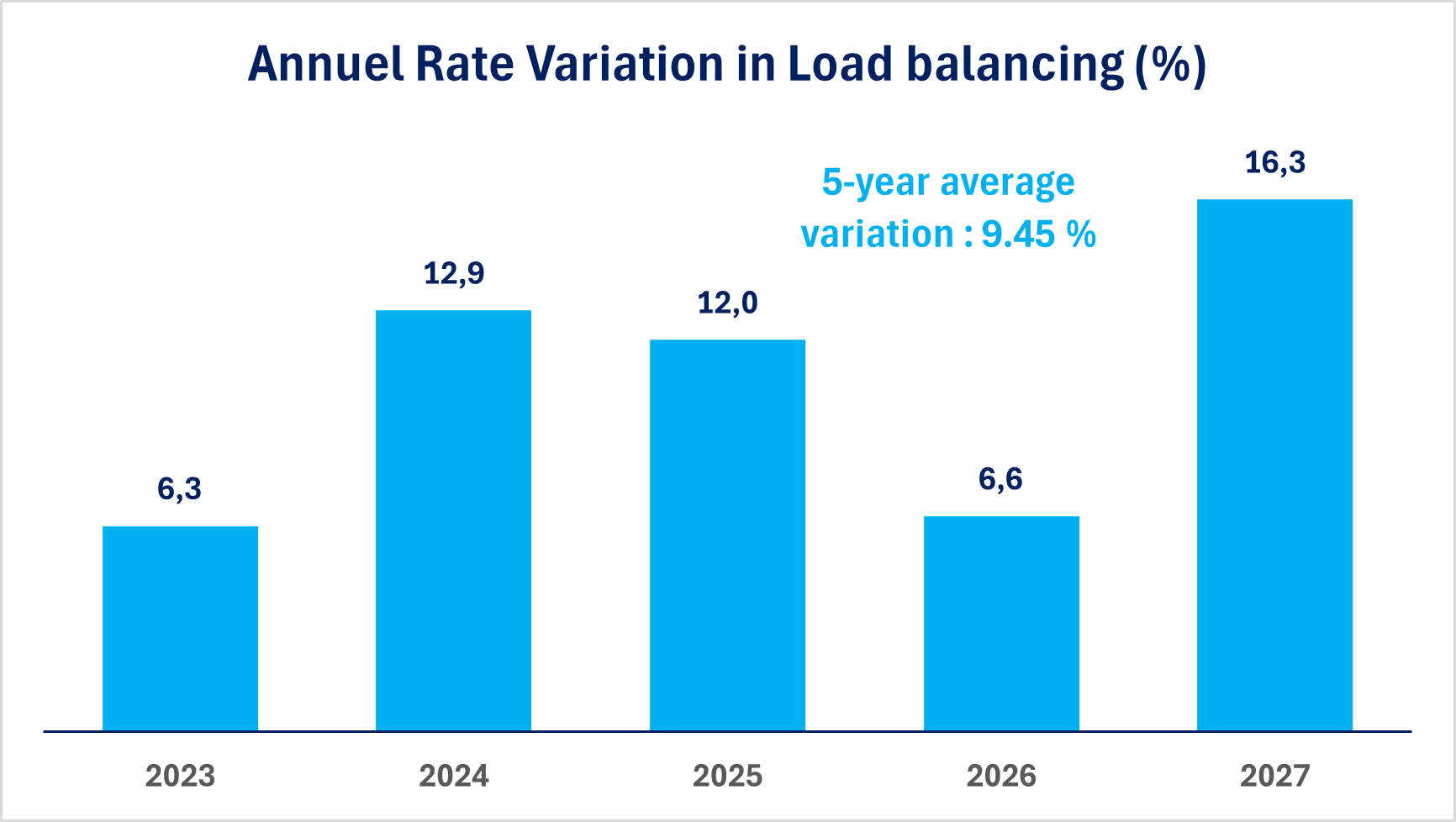
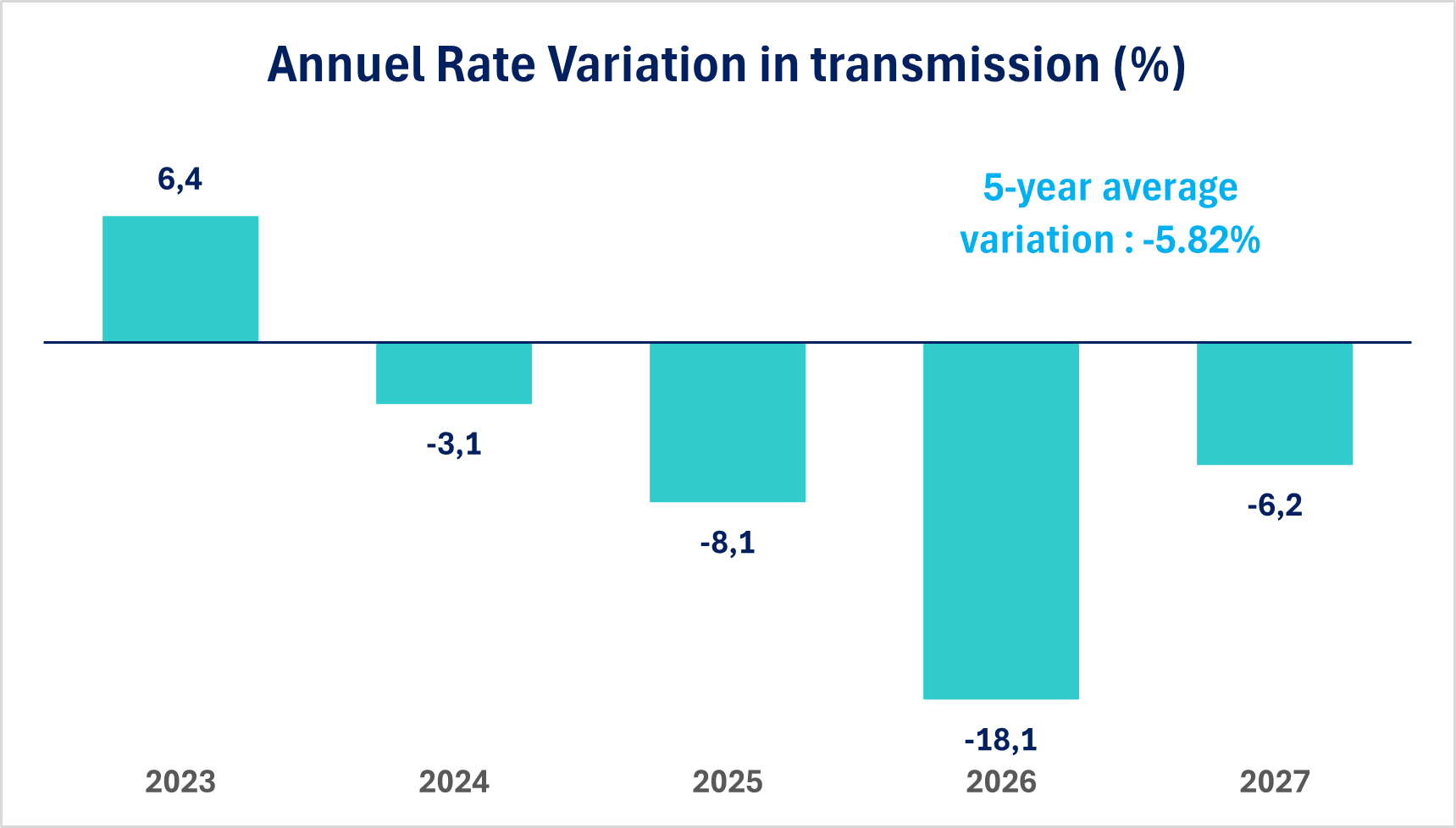
For Énergir's distribution, transmission and load-balancing services, the 2026–2027 rate case reflects a 1.8% reduction in rates, or $19.1 million, compared with the rates approved for 2025–2026, which can be summarized as follows:
- distribution rate decrease of 5.6%, or $41.1 million;
- transmission rate decrease of 6.2%, or $8.6 million;
- load balancing rate increase of 16.3%, or $30.6 million.
As for the GRS socialization fee, it increased significantly by $228.3 million, primarily due to the increase in the regulatory GRS threshold.
- The decrease in Énergir’s distribution rates (-$41 million) is mainly attributable to the following:
- the combined impact of amounts to be recovered and refunded under the weather normalization mechanism for previous fiscal years (-$39.8 million);
- higher amounts to be refunded to customers under the revenue decoupling mechanism for the last eight months of fiscal 2024–2025 and the first four months of fiscal 2025–2026 (-$22.0 million).
- These decreases are partially offset by a $15.8 million increase in cost-of-service components related to other operating revenues, property taxes and the depreciation and amortization of fixed assets, commercial programs and intangible assets.
The decrease in transmission rates (-$8.6 million) is primarily due to a $5.3 million reduction in depreciation and amortization resulting from the overpayment recorded in fiscal 2024–2025.
The increase in load balancing rates (+$30.6 million) is mainly driven by a $37.5 million increase in load-balancing costs resulting from the supply deficit on the TCPL (TransCanada PipeLines Limited) system and Énergir’s use of the secondary market to secure peak winter supply requirements for the 2026–2027 winter season.
Overall, the proposed rate change for transmission, load balancing and distribution services is -1.8%. The details by service are shown in the table below.
| Service | Rate |
| Transmission | -6,19% |
| Load balancing | +16,28% |
| Distribution | -5,61% |
To view the rate changes for transmission (T), load-balancing (B), cap-and-trade compliance adjustments (I), distribution (D) and the RNG socialization fee (S) for each rate class.
A decrease in distribution rates is proposed for 2026–2027. In addition, transmission costs continue to decline. These decreases offset the increase in load balancing costs.
The significant increase of $228.3 million in GRS socialization fees is attributable to:
- A $184.5 million increase in socialization costs resulting from projected unsold GRS volumes relative to the 5% threshold for 2026–2027 under the Regulation respecting the quantity of gas from renewable sources, in accordance with the proposed new calculation methodology.
- A $33.0 million increase in amortization related to the integration of unrecovered balances accumulated during 2024–2025 and 2025–2026 through a rate rider. These balances will be amortized over a three-year period.
Effective October 1 and subject to Régie de l’énergie’s approval of the proposed new calculation methodology, the socialization fee will consist of the following components:
- A forecast component of 3.103¢/m³.
- A rate rider component of 1.697¢/m³.
See the February Blue Bulletin for more information.
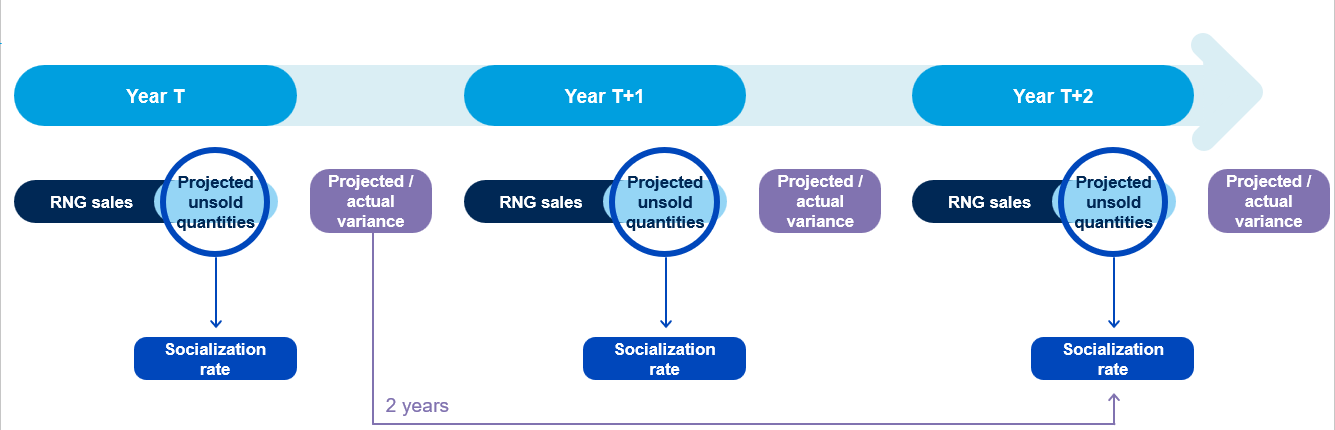
For reference, the calculation methodology currently awaiting approval
This new approach consists of establishing GRS socialization fees on a forecast basis rather than based on unsold volumes from two years earlier relative to the regulatory target. This change is intended to improve intergenerational equity among customers, reduce financing costs associated with unsold GRS volumes, including return and tax impacts, and provide a fairer allocation of costs.
Price of Gas from Renewable Sources (GRS)
GRS fee
As part of the 2026–2027 rate case, the renewable natural gas (GRS) supply rate is expected to decrease slightly. Subject to approval by the Régie, it will decrease from $25.04/GJ (94.884¢/m³) to $24.76/GJ (93.835¢/m³).
The rate reflects the projected average cost of GRS purchases for the coming 12 months, including a modest increase in the acquisition cost of the RNG volumes required to meet the 5% regulatory obligation.
The proposed rate also incorporates the monetization of compliance units (CUs) included in the 2026–2027 rate case, valued at $13 million, resulting in a reduction of approximately 4.1¢/m³ (-$1.08/GJ) in the RNG rate. This cost-reduction strategy remains subject to a decision by the Régie, expected in June 2026.
Draft regulation amending the Regulation respecting gas from renewable sources
On April 22, the Quebec government published draft amendments to the Regulation respecting gas from renewable sources (R-6.01, r. 3.01).
The proposed amendments include:
- Postponing the 10% regulatory GRS injection target to 2032–2033.
- Introducing progressively increasing GRS sales requirements for existing building-sector customers.
- Requiring GRS service for all new building-sector connections as of October 1, 2026.
These changes would lead to lower unsold GRS volumes and reduced GRS socialization fees.
A consultation period is underway until June 6, 2026. Final adoption is expected by late summer, with the amendments coming into force on October 1, 2026.
We will communicate with you promptly once the Quebec government has formally adopted these regulatory amendments.