







Énergir’s Fall 2026 Rates and Terms of Service
The new rates proposed by Énergir were filed with the Régie de l’énergie on May 14 and are pending approval for introduction on October 1 , 2026.
Learn more about our price changes in each section.
- Price of Énergir’s services:
- Renewable natural gas (RNG) :
Price of Énergir’s services
The proposed rate changes for Énergir’s transportation, load balancing and distribution services would represent an overall decrease of 1.8% for the 2026-207 rate year. However, RNG socialization fees are up sharply this year and will result in overall upward price movement as of fall 2026.
Variations by service are shown in the table below.
| SERVICE | RATE VARIATION |
| DISTRIBUTION | - 5.6% |
| TRANSMISSION | - 6.2% |
| LOAD BALANCING | + 16.3% |
| CATS | + 0.76% |
| RNG SOCIALIZATION FEES | 0.96¢/m3 to 4.41¢/m3 |
What impact on your annual bill?
Assess how rate changes could affect your annual costs based on your consumption profile.
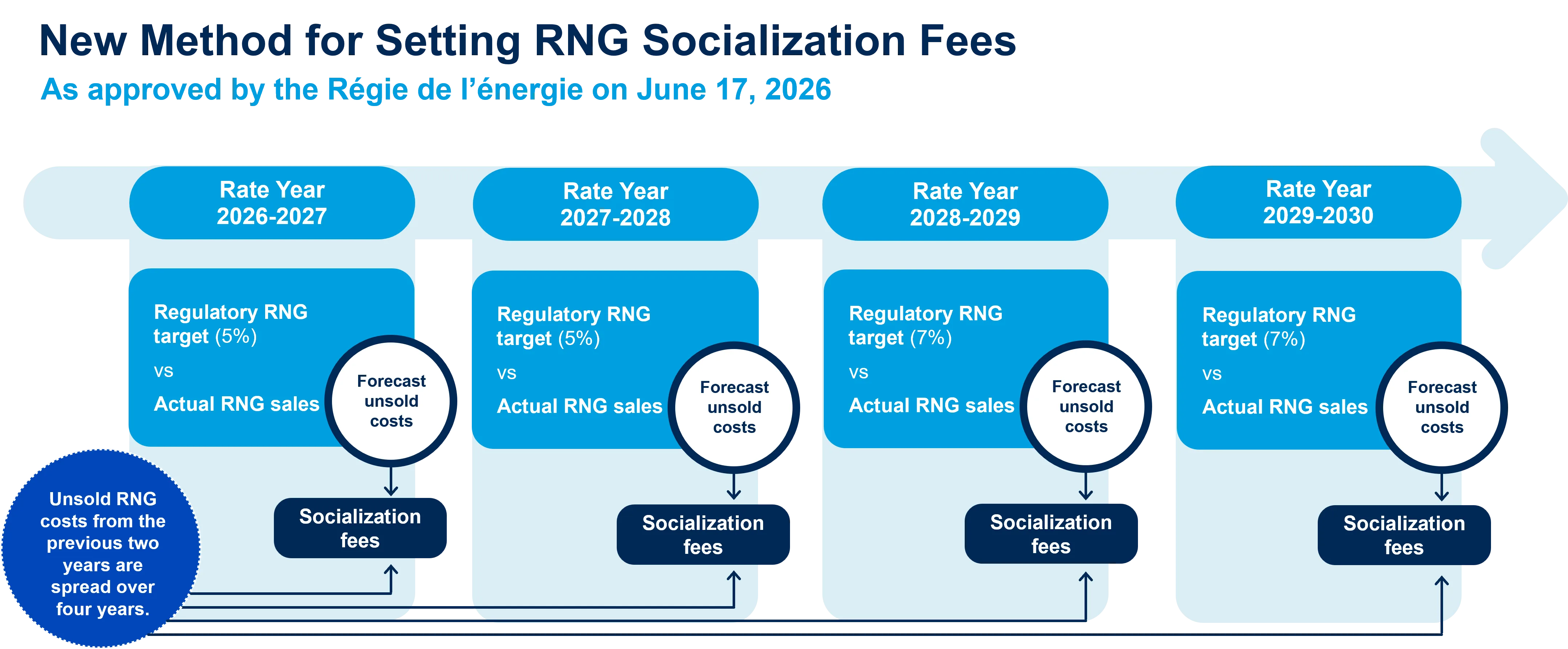
The sharp increase in RNG socialization fees is mainly due to the use of a new calculation method approved by the Régie de l’énergie on June 17.
This approach changes the way unsold RNG volumes are accounted for and distributed, resulting in:
- An increase in costs related to projected unsold RNG volumes for 2026‑2027 based on the 5% regulatory requirement.
- Amortization of $33 million corresponding to the outstanding balances of 2024‑2025 and 2025‑2026 (rate jumper) spread over four years.
Effective October 1, 2026, socialization fees will be based on two components calculated separately and then combined into a single rate on the bill :
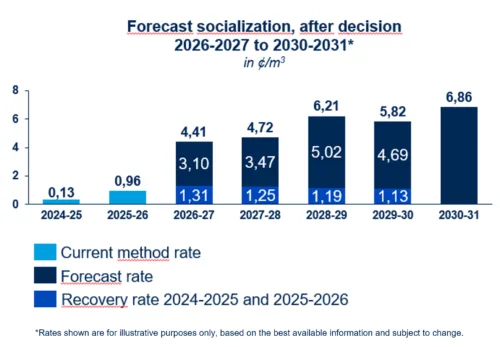
- A rate rider component (recovery rate) : used to recover the costs of RNG that was not purchased over the past two years, relative to the regulatory target. This recovery is spread over four years to mitigate the impact on the bill. Rate for 2026-2027: 1.311 ¢/m3
- A forecast component (forecast rate) : used to estimate the cost of the RNG volumes that are not expected to be purchased, relative to the regulatory target. Rate for 2026–2027: 3.103 ¢/m3
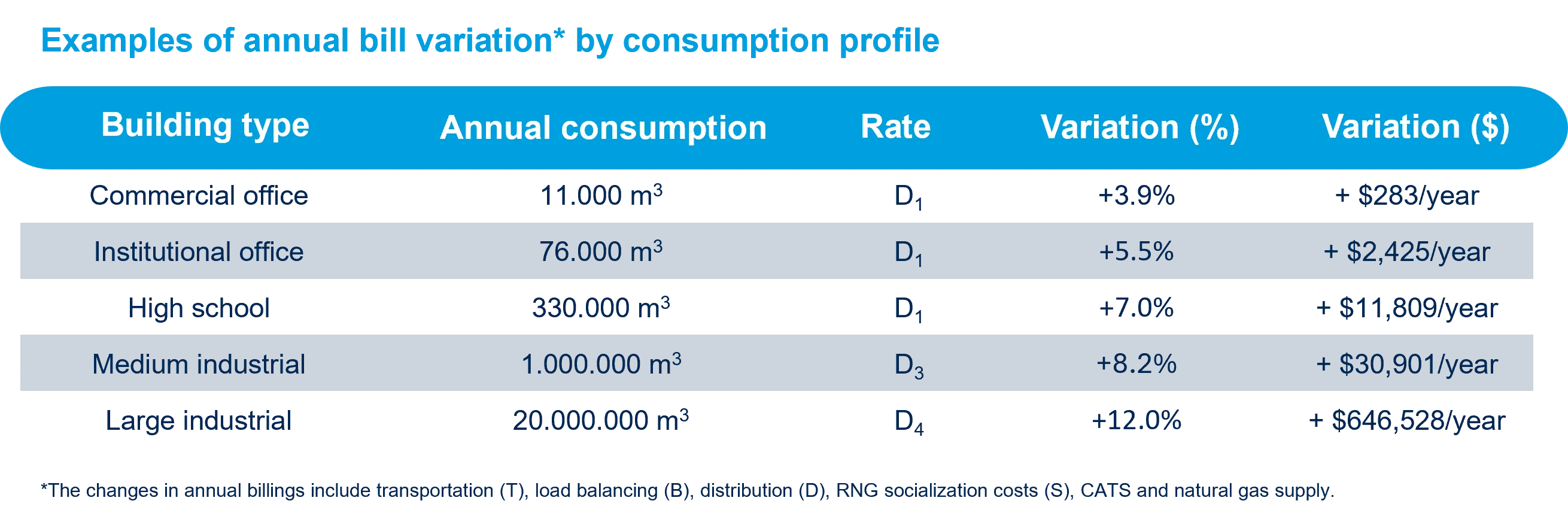
Rate adjustments will have a variable impact on annual Énergir billings to customers depending on their natural gas consumption and inclusion in a specific rate tier.
The table below illustrates the impact of price changes on annual billings for different customer profiles, expressed in both percentage and dollar terms. These examples are provided for illustrative purposes, to help you better understand the potential impact of rate changes on your energy costs and to plan your upcoming fiscal year accordingly.
Renewable Natural Gas (RNG)
As part of the 2026-2027 rate case, the renewable natural gas (RNG) supply rate is expected to decrease slightly. Subject to approval by the Régie, it will decrease from $25.04/GJ (94.884¢/m3) to $24.76/GJ (93.835¢/m3).
This drop is mainly due to the monetization of compliance units (CUs). With an estimated $13 million in Cus, this reduces the rate by about 4.1¢/m3 (-$1.08/GJ).
In November 2025, Énergir proposed a new approach to calculating RNG socialization fees, which was approved by the Régie de l’énergie on June 17. This method will therefore come into effect on October 1, 2026, for rate year 2026‑2027.
What is changing
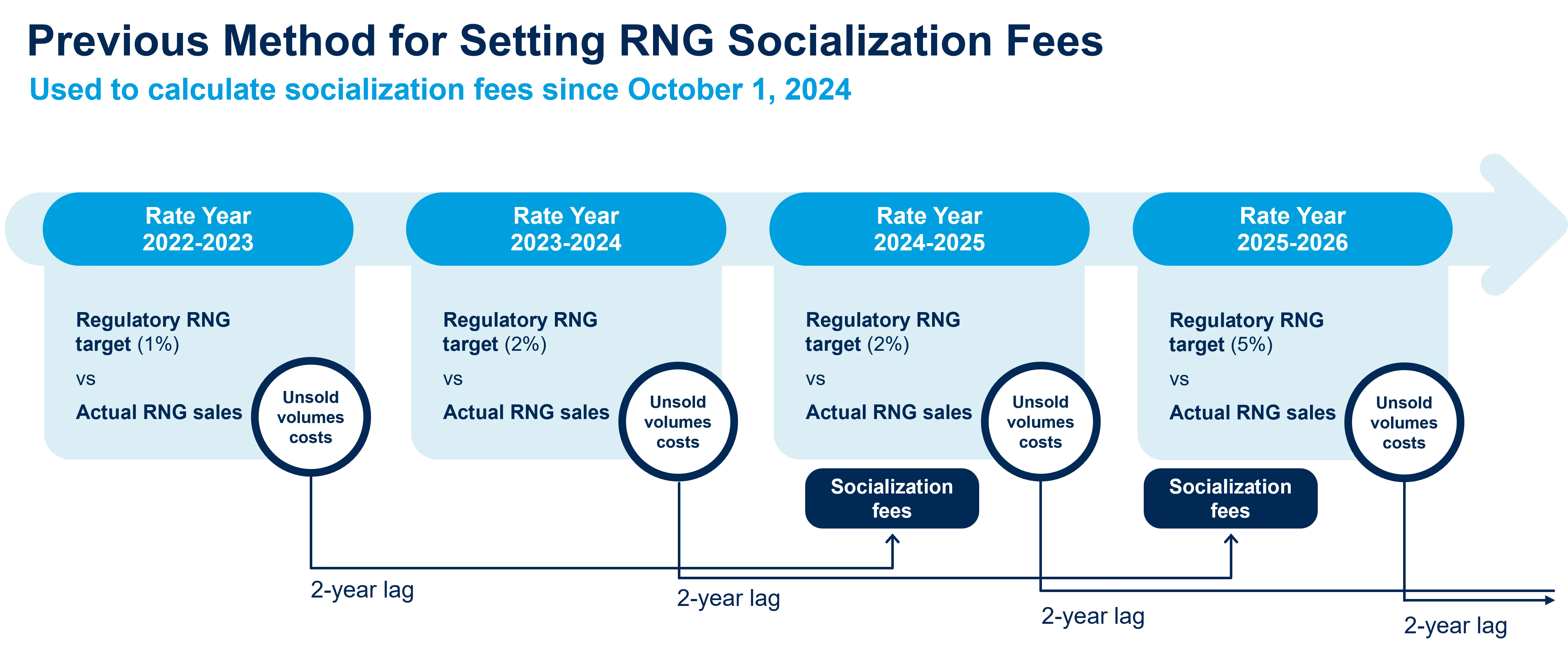
Fees will now be forecasted for the current rate year rather than based on unsold RNG volumes observed against regulatory targets from previous years, as was the case for 2024-2025 and 2025-2026.
Why it is changing
This change is intended to improve intergenerational equity among customers and reduce financing costs associated with unsold RNG volumes (including return and tax impacts).
Have questions about RNG socialization fees?
This is a fee used to allocate the costs associated with the volume of RNG required for Énergir to meet its regulatory obligations, but that has not been voluntarily purchased by customers.
Énergir must comply with regulatory requirements set by the Government of Québec, which require gas distributors to supply a minimum proportion of RNG. This regulatory threshold was set at 2% for the 2023–2024 and 2024–2025 rate years, and has increased to 5% starting in 2025–2026.
When this minimum is not fully met through voluntary purchases, Énergir must still meet its obligation. In such cases, and in accordance with its Conditions of Service and Tariff, the cost of the unsold RNG volumes is allocated to customers who have not purchased at least the required proportion of RNG relative to their natural gas consumption.
As of October 1, 2026, socialization fees will be based on two components:
- A rate rider component : used to recover the cost of unsold RNG from the 2024–2025 and 2025–2026 rate years. It applies to the majority of Énergir customers, specifically those who did not purchase at least 5% RNG in 2025–2026. This adjustment, resulting from the change in the calculation method, is spread over four years to mitigate its impact on customer bills. Estimated at 1.311¢/m3 for 2026–2027.
- A forecast component : represents an estimate of the RNG volumes that are not expected to be sold in 2026–2027. It applies only to customers who do not meet the regulatory target. Customers who purchase RNG at the required level (5% in 2026–2027) are not subject to this component. Estimated at 3.103¢/m3 for 2026–2027.
These two components are calculated separately and, where applicable, combined into a single rate on the customer’s bill, applied to each cubic metre (m³) of fossil natural gas consumed.
Due to the new calculation method, RNG socialization fees are expected to reach 4.41¢/m3 as of October 1, 2026. You can reduce a portion of these fees by purchasing at least 5% RNG monthly based on your total natural gas consumption. By meeting this regulatory threshold, you will be exempt from the forecast component, estimated at 3.103¢/m3 for 2026–2027.
Énergir encourages customers to evaluate voluntary RNG purchases based on their consumption profile, environmental objectives, and financial capacity.
As of October 1, 2026, for the vast majority of customers, purchasing RNG at 5% on a monthly basis will represent a total cost comparable to paying socialization fees alone.
Decarbonization Incentive Program (DIP)
Énergir currently offers a financial incentive under the DIP for customers who purchase RNG at a minimum of 5% of their annual natural gas consumption over a five-year period. For more details about the program, please contact your Énergir representative.