








What you need to know
The Québec government has set RNG distribution targets to gradually increase the share of renewable energy in Québec’s gas networks.
The current RNG target (regulatory threshold) requires RNG to represent 5% of the total volume of natural gas distributed during the current rate year.
What is renewable natural gas?
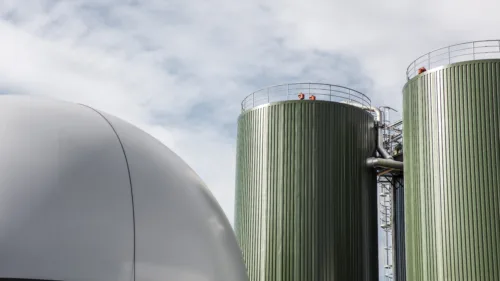
Renewable natural gas (RNG) is renewable energy produced from residual organic waste. As this waste decomposes naturally, it generates biogas, a gas that can be recovered, purified, and transformed into RNG.
What does this mean for your organization?
RNG volumes acquired by Énergir to meet the regulatory threshold can be purchased by customers. If these volumes are not purchased in full, the additional cost of the unsold RNG volumes compared with fossil natural gas is allocated to applicable customers through socialization fees in accordance with the rules set out in our Conditions of Service and Tariff.
Your RNG options
Depending on your needs, preferences, or the requirements that apply to your service address, you can purchase a percentage of RNG to replace part or all of your fossil natural gas purchase. You have two options.
Purchase a percentage of RNG
This option is suitable for customers looking to meet their fossil-based greenhouse gas (GHG) emissions reduction targets.
You can choose the percentage of RNG you wish to purchase. The corresponding volume is billed at the RNG supply rate, while the remaining volume is billed at the natural gas supply rate.
Continue with your current service
This option is suitable for customers who simply wish to continue their natural gas service without changing their purchase profile.
You will continue to be billed at the natural gas supply rate and will continue to pay the RNG socialization fees applicable under Énergir’s Conditions of Service and Tariff.
What are the benefits of purchasing RNG for your organization?
Purchasing RNG can be part of a decarbonization initiative or a broader energy strategy. In addition to potentially being accounted for in your carbon footprint, subject to the applicable quantification standard¹ selected, purchasing RNG may also reduce certain applicable fees. Depending on the proportion purchased and the applicable terms and conditions, it may notably reduce RNG socialization fees as well as costs associated with Québec’s cap-and-trade system (CATS).
Although RNG is priced higher than fossil natural gas, these reductions may help mitigate the overall cost difference.
Gain access to renewable energy without changing your existing equipment
Improve your building’s carbon footprint
Reduce certain costs associated with your energy bill

Access a grant to support your initiative
How can you integrate the purchase of RNG into your energy strategy?
There is no one-size-fits-all approach to integrating RNG into your energy strategy. Depending on your decarbonization objectives, your consumption profile, and your investment capacity, you can gradually increase your level of commitment and combine RNG with other complementary solutions.
1
Before buying RNG, consider reducing your energy consumption
2
Start with a percentage of RNG that works for you
3
Aim for Renewable Energy Through a Combination of Measures and RNG
4
Enhance Your Decarbonization Journey Through a Long-Term Commitment
Even before increasing the share of renewable energy in your supply, it may be wise to reduce your energy needs through energy-efficiency measures or by adopting hybrid solutions such as dual-energy electricity-natural gas.
Gradually reducing your natural gas consumption makes it easier and more affordable to incorporate a higher proportion of RNG into your energy strategy.
Énergir can assist you through various energy efficiency and dual-energy grant programs to support your projects.
Once you have invested in energy efficiency, purchasing RNG can be an attractive way to accelerate the decarbonization of your operations. The 5% threshold is often a good starting point for integrating RNG into your energy strategy.
Why start at 5%?
- Aligns with the current regulatory threshold;
- Although RNG is priced higher than fossil natural gas, purchasing RNG at a level equivalent to the regulatory threshold can reduce RNG socialization fees and costs associated with Québec’s cap-and-trade system (CATS), helping to narrow the overall cost difference.
After reducing your energy needs through energy efficiency measures, dual-energy systems or other decarbonization initiatives, it may become more feasible to increase the proportion of RNG you purchase. For some organizations, this approach may eventually make it possible to meet all of their remaining natural gas needs with purchase of RNG.
RNG can complement decarbonization efforts already in place by addressing energy uses that remain difficult to reduce or transition to other energy sources, helping organizations move closer to ambitious environmental and decarbonization goals.
RNG as complementary energy
- Reduces residual fossil-based GHG emissions;
- Contributes to ESG and decarbonization objectives.
For organizations planning to maintain their RNG purchases over the long term, Énergir offers the Decarbonization Incentive Program (DIP).
By committing to purchase RNG for a minimum of five years, you may be eligible for a grant designed to support your decarbonization efforts. This option may be particularly attractive for organizations looking to integrate RNG into their energy strategy on a long-term basis.
The benefits
- Eligibility for a grant of up to $200 per ton of fossil-based GHG avoided under the DAP*.
* Talk to your Énergir representative or contact our team to learn more about the program’s terms and conditions.
1
Before buying RNG, consider reducing your energy consumption
Even before increasing the share of renewable energy in your supply, it may be wise to reduce your energy needs through energy-efficiency measures or by adopting hybrid solutions such as dual-energy electricity-natural gas.
Gradually reducing your natural gas consumption makes it easier and more affordable to incorporate a higher proportion of RNG into your energy strategy.
Énergir can assist you through various energy efficiency and dual-energy grant programs to support your projects.
2
Start with a percentage of RNG that works for you
Once you have invested in energy efficiency, purchasing RNG can be an attractive way to accelerate the decarbonization of your operations. The 5% threshold is often a good starting point for integrating RNG into your energy strategy.
Why start at 5%?
- Aligns with the current regulatory threshold;
- Although RNG is priced higher than fossil natural gas, purchasing RNG at a level equivalent to the regulatory threshold can reduce RNG socialization fees and costs associated with Québec’s cap-and-trade system (CATS), helping to narrow the overall cost difference.
3
Aim for Renewable Energy Through a Combination of Measures and RNG
After reducing your energy needs through energy efficiency measures, dual-energy systems or other decarbonization initiatives, it may become more feasible to increase the proportion of RNG you purchase. For some organizations, this approach may eventually make it possible to meet all of their remaining natural gas needs with purchase of RNG.
RNG can complement decarbonization efforts already in place by addressing energy uses that remain difficult to reduce or transition to other energy sources, helping organizations move closer to ambitious environmental and decarbonization goals.
RNG as complementary energy
- Reduces residual fossil-based GHG emissions;
- Contributes to ESG and decarbonization objectives.
4
Enhance Your Decarbonization Journey Through a Long-Term Commitment
For organizations planning to maintain their RNG purchases over the long term, Énergir offers the Decarbonization Incentive Program (DIP).
By committing to purchase RNG for a minimum of five years, you may be eligible for a grant designed to support your decarbonization efforts. This option may be particularly attractive for organizations looking to integrate RNG into their energy strategy on a long-term basis.
The benefits
- Eligibility for a grant of up to $200 per ton of fossil-based GHG avoided under the DAP*.
* Talk to your Énergir representative or contact our team to learn more about the program’s terms and conditions.
Join a community of committed businesses
A phased approach for the Bell Centre
Currently, 50% of our natural gas (purchase) is RNG, and we are aiming to reach 100%. By investing in RNG, we’re not directly reducing (fossil-based GHG emissions) within the building, but rather within the community and the distribution system (…) Being a good corporate citizen is a responsibility.
Patrick Auger
Vice President, Operations and Facilities
ADM Aéroports de Montréal chooses RNG to meet its decarbonization targets
Using RNG (…) aligned with our corporate values of being a leader in sustainable development.
Martine St-Arnaud
Assistant Director, Energy Efficiency | Life Cycle Projects
We didn’t have to make any changes to our equipment. All we had to do was set aside the volumes we had identified to reduce our (fossil-based) GHG emissions.
Jonathan Roy
Director, Infrastructure Maintenance | Building and Planning
Ready to assess the potential of RNG for your organization?
Whether you want to meet the regulatory threshold, take advantage of the Decarbonization Assistance Program (DAP), or integrate more renewable energy into your energy strategy, our representatives and advisors can help guide you through the process.
Questions?
We've got answers.
As of October 1, 2026, the price of RNG is 85.239 ¢/m3 or $22.49/GJ. The RNG supply rate is set annually as part of the rate case filed each year with Régie de l’énergie.
The emission allowance cost associated with natural gas combustion, under Québec’s cap-and-trade system, does not apply to the proportion of RNG purchased.
To find out more, visit the page Pricing and Rates.
No, no equipment modifications are required, since RNG and fossil natural gas are interchangeable and flow through the same gas distribution system. RNG can therefore be used for the same purposes.
In fact, this is why RNG purchases are considered accounting-based rather than physical: it is not possible to distinguish which gas molecules are delivered directly to your equipment.
If no purchase requirement or fixed-term agreement applies to your building, you may request a change to the amount of your voluntary renewable natural gas purchase at any time.
As a customer, for a change to come into effect on the 1st of the following month, submit your request no later than the 20th of the current month. Requests received after the 20th of the month will be processed with the following month’s requests. Change requests are made by phone with the Énergir team, specifying the revised percentage purchase and the desired effective date. To contact us, call 1 800 563-2021.
There is no way to confirm the exact amount of purchased RNG that is delivered to your devices, since RNG and fossil natural gas flow through the same gas distribution and the molecules are thoroughly mixed together. The same is true for the electricity you purchase: you can’t tell which dam or wind turbine generated the electrons that are lighting your home.
The quantity that is purchased by a customer differs from the quantity that is physically transported to the customer’s devices. Énergir has put stringent measures in place to periodically ensure that its total annual supply from RNG producers to replace fossil natural gas is at least equal to the quantity purchased by all its customers and that the RNG it purchases is 100% organic (and does not include any fossil molecules). After the end of every year, Énergir has its RNG supply and inventory verified by an independent verification body.
The RNG volumes you purchase are shown on your detailed total natural gas consumption bills.
To meet the regulatory RNG targets, Énergir sources RNG from local producers, but primarily from producers located in the United States. Énergir is working to increase its supply from producers in Quebec, subject to availability. The amount of RNG purchased by Énergir from each producer is injected by the producer into the gas distribution system in the region where the producer is located. It can be injected into the gas distribution system of Énergir or another distributor in North America and it is then blended with the fossil natural gas flowing through the same distribution system. The two then become inseparable. For example, as is the case with Énergir’s supply of fossil natural gas or the supply of electricity, once the purchased energy is injected into the gas distribution system or the power system, the gas molecule or electron cannot be physically tracked. The gas molecule or electron is consumed by the different users connected to these systems. The amount of RNG purchased by Énergir reduces the quantity of fossil natural gas that Énergir purchases as part of its overall supply.
RNG combustion is not emission-free; it generates GHG emissions (CO2, CH4 and N2O) just like the combustion of fossil natural gas. CO2 is the main GHG that is generated (over 99% of combustion emissions). For RNG, though, the CO2 emissions from its combustion are said to be biogenic because they come from biomass. Biogenic CO2 emissions are not generally targeted by climate change objectives, unlike emissions from the combustion of fossil natural gas. Although CO2 from the combustion of fossil natural gas can be reabsorbed by biomass during photosynthesis, burning fossil natural gas releases CO2 that has been sequestered for millions of years in geological formations and results in a net addition of CO2 to the atmosphere. In contrast, the CO2 released into the atmosphere from RNG combustion (biogenic CO2) was sequestered in organic matter (food waste, manure, wastewater, etc.), which renews much more rapidly, on a scale ranging from a few months to a few years. The biogenic CO2 was present in the atmosphere, was absorbed by organic residues and could be again re-emitted into the atmosphere. BiogenicCO2 is therefore part of the short carbon cycle. The actual effect of biogenic CO2 emissions from RNG combustion on the climate depends on a number of factors, including the biomass source and production processes. RNG sold by Énergir to its customers is produced from organic waste and has not led to significant changes in land use.
Subject to applicable quantification standards, customers may account for the amount of RNG purchased, whether voluntarily or to meet a requirement, in their GHG inventory.
For more information on how the various GHG emissions associated with the combustion of RNG purchased voluntarily or to meet a requirement are accounted for in a GHG emissions inventory, see the question below: “How are GHG emissions from RNG combustion are accounted for (GHG inventory)?”.
Énergir generally relies on Protocol QC.30, “Fuel and Combustible Distribution,” which applies to fuel and combustible distributors (such as Énergir) under the RMRCECA, to quantify emissions related to the combustion of fossil natural gas and RNG.
Énergir provides a reference page detailing the methodologies for calculating and demonstrating greenhouse gas (GHG) emissions associated with its decarbonation offers. For more information on the methodology used to calculate GHG emissions from RNG, see the relevant section.
Énergir has switched to voluntarily purchasing RNG for the buildings it owns. For example, Énergir purchases RNG for its eight regional business offices, its head office, the École de technologie gazière, and the LSR plant in an amount equivalent to its consumption of fossil natural gas for these facilities. This choice directly supports our objective to reduce fossil-based GHG emissions from our facilities and is part of meeting the decarbonization targets for buildings in Quebec.
Legal notices
1. Énergir generally relies on Protocol QC.30, “Fuel and Combustible Distribution,” which applies to fuel and combustible distributors (such as Énergir) under the RMRCECA, to quantify emissions related to the combustion of fossil natural gas and RNG.
Énergir provides a reference page detailing the methodologies for calculating and demonstrating greenhouse gas (GHG) emissions associated with its decarbonation offers. For more information on the methodology used to calculate GHG emissions from RNG, see the relevant section.
2. The Regulation respecting mandatory energy consumption reporting for large buildings stems from the Act respecting the environmental performance of buildings (introduced through Bill 41), which was adopted by the Québec National Assembly in March 2024. For more information, visit the Québec government webpage on mandatory energy consumption reporting for large buildings (in French only).