







Express Blue Bulletin
Major Industries
February 2026

New RSG socialization fee calculation method
At the 2025-2026 Rate Case hearing, the Régie de l’énergie and several stakeholders expressed concerns about the increase in RSG (renewable natural gas) socialization fees charged to customers, as well as the current method used to recover them. In response, Énergir proposed to change the socialization fee calculation method. This new calculation method is pending approval by the Régie. If accepted, it would be implemented on October 1, 2026.
In summary, the new approach would establish RSG socialization fees on a forecast basis rather than through a two-year deferral. This change is intended to improve equity between generations of customers, reduce the financial costs associated with unsold RNG units (such as performances and income taxes), and provide a fairer distribution of costs.
Please take a moment to read our detailed proposal below and feel free to contact your advisor should you have any questions.
Current RNG socialization fee calculation method
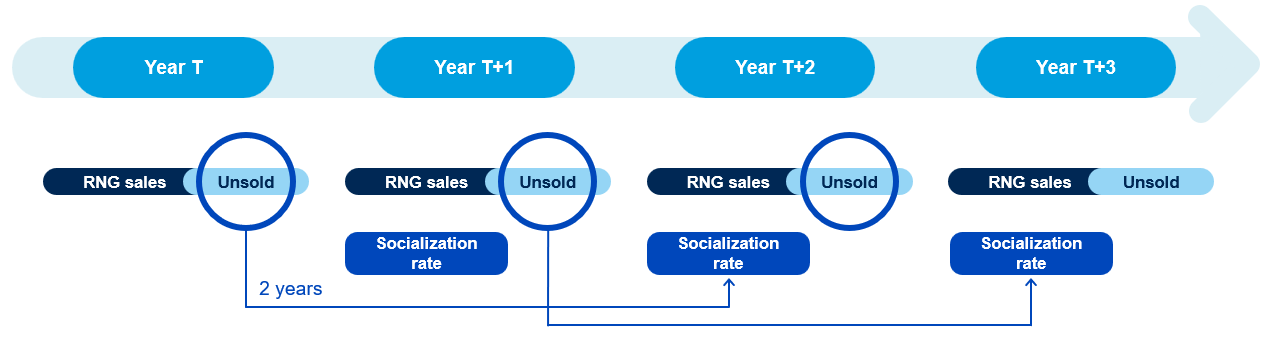
At the end of each fiscal year, unsold RSG quantities are accounted for, and their value is recovered through the T+2 rate case, meaning two years later.
This approach has two significant consequences:
- The transit of socialization costs through a deferred expense account (DEA) for two years results in additional performance and income tax costs that must be borne by customers.
- A less equitable distribution of costs across generations of customers, as those who pay are not necessarily the ones who triggered the socialization costs.
Proposed calculation method
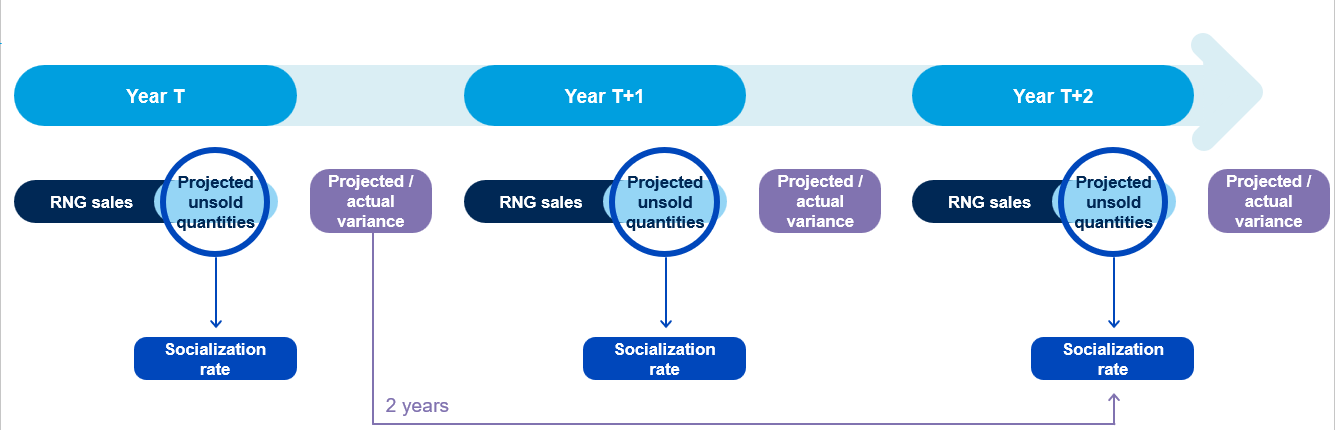
Our proposal presented to the Régie aims to calculate socialization fees on a forecast basis, rather than with a two-year deferral.
The proposed method consists of the following:
- At the beginning of the fiscal year, a projection is prepared for voluntary RSG purchases, as well as expected unsold inventory;
- At the end of each fiscal year,: the variance between projected and actual is calculated and recovered through the T+2 rate case.
This new method means that:
- The rate would be set on a forecast basis, in the current year (year T) rate case;
- Anticipated costs for unsold RSG units would be recovered immediately, rather than deferred for two years;
- Additional performance and income tax costs would be significantly reduced;
- A deferred expense account would remain in place to record variances from actual results, but the amounts processed through it would be much smaller.
Impact of the transition to the new method
Eliminating the two-year deferral creates an unrecovered balance of socialization costs for the 2024-2025 and 2025-2026 rate years. Tto avoid a rate shock, Énergir proposes to recover this balance over a three-year period, and only from customers who do not meet the regulatory RSG purchase threshold of 5% on an annual basis for the fiscal year ending September 30, 2026.
Énergir therefore proposes a socialization fee based on the following two components:
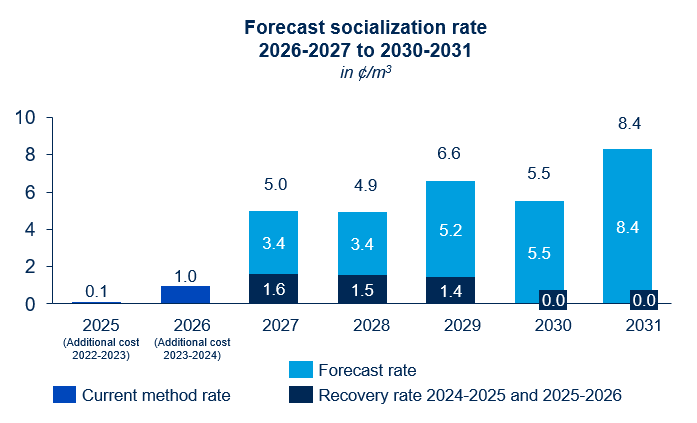
- Component 1 : 2026-2027+ Forecast Rate
- Objective : Recover the forecast balance of the RNG quantities expected to be unsold at the 2026-2027 Rate Case.
- Customers involved : All customers buying below the overall regulatory threshold; applicable to their residual fossil natural gas (FNG) purchase. Recognition of the effort of customers purchasing at least the regulatory threshold is maintained.
- Component 2 : Unsold RNG in 2024-2025 and 2025-2026
- Objectif: Recover the balance of unsold RSG quantities for 2024-2025 and 2025-2026.
- Customers involved : all customers who did not voluntarily purchase the threshold RSG quantity for fiscal year 2025-2026 (5%). This rate will be applicable on the residual RSG purchase.
Regardless of the mix of components attributable to a customer, the invoice will show a single line: Customer socialization rate X customer’s FNG volumes
Socialization rate evolution
Several elements could mitigate the magnitude of the RSG socialization rate in the coming years, such as the valuation of compliance units (CUs) and regulations in the building sector. The Régie is currently reviewing many cases related to this matter.
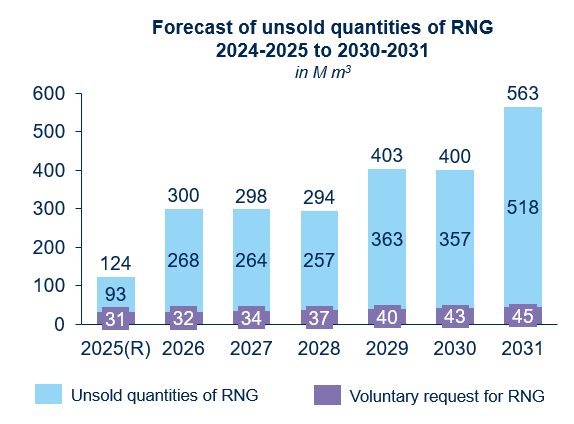
Based on customer demand, here are the forecasts our teams produced. Note that these figures are not final, may vary and have not been approved by the Régie de l’énergie:
Have questions about RSG socialization fees?
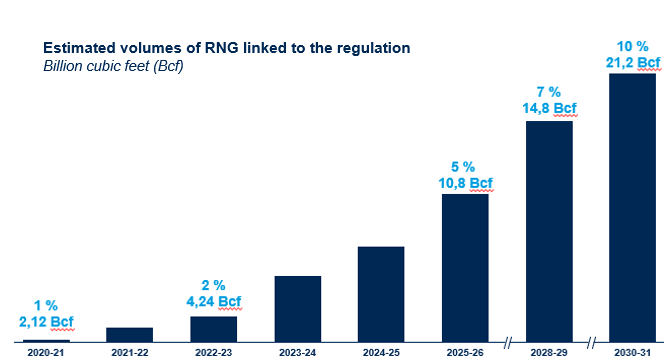
Énergir must comply with the regulatory obligations set out by the Government of Quebec, which requires gas distributors to have at least 2% RNG in their network by 2023-2024, followed by 5% RSG by 2025-2026, and 10% by 2030-2031.
In order to meet these regulatory obligations, when a specified amount of RSG is not voluntarily purchased by customers, Énergir must socialize the associated costs withamong customers who do not purchase the minimum quantity set by the regulation (i.e., 5% for 2025-2026). Therefore, as of October 1, 2024, the costs associated with unsold RSG volumes are recovered from all volumes consumed by these customers over a one-year period.
RSG socialization fees amount to 0.960¢/m³ for the 2025–2026 Rate Case. These fees are expected to represent less than 2.1% of an average customer’s total bill.
Customers whose RSG purchase exceeds the target set by the government regulations are not subject to RSG socialization fees.
Corporate customers were notified at each stage and through various means:
- through express blue bulletins:
- May 2024 Express BB: to announce the addition of the RNG socialization fee as of October 1, 2024
- October 2024 edition of the Express BB
- May 2025 Express BB
- October 25 Express BB
- at each corporate customer event since 2024 and 2025 , a presentation was given on the topic and customers were given the opportunity able to ask their questions
- through their dedicated advisor
Under the Regulation Respecting Gas from Renewable Sources (R-6.01, r. 3.01), the Government of Quebec requires gas distributors to supply increasing minimum quantities of renewable gas to their distribution networks each year for end-user consumption within the territory, with the objective of reaching at least 10% by the 2030-2031 fiscal year.
Renewable source gases (RSG) are gases produced from organic materials or renewable energy whose properties allow for direct integration into the gas distribution network, such as green hydrogen and renewable natural gas (RNG).
Renewable natural gas (RNG) is produced from organic waste originating from farms, forests, landfills and water treatment plants. It is collected, purified, and injected into the gas grid for use in the same applications as conventional natural gas. It is fully interchangeable with traditional fossil natural gas.
Source: FAQ | Renewable source gas | Régie de l’énergie (French only)