






Choosing how much RNG to buy is easy!
Add the voluntary purchase of RNG to your profile based on your needs and objectives. You have two options:
What does it mean to voluntarily purchase a certain amount of GNR?
By voluntary purchasing a percentage of RNG, you replace the purchase of a quantity of fossil natural gas with an equivalent quantity of renewable energy, which helps combat climate change.
Watch the video to better understand your RNG purchase.
When you purchase renewable natural gas, you’re helping to improve your GHG balance, because your purchase of RNG replaces the purchase of an equivalent amount of fossil natural gas.
Since RNG and fossil natural gas circulate in the same north-american gas distribution system, their molecules mix together, making it impossible to confirm the exact quantity of RNG molecules that will reach your devices. While we cannot physically deliver to you the percentage of RNG purchased, your share is exclusively attributed to you and is reflected on your bill. Your purchase of RNG helps improve your GHG balance by reducing the GHG emissions targeted by the fight against climate change.
In addition, Énergir guarantees that the total amount it procures from RNG producers is greater than the quantity purchased by all its customers, as verified by the Bureau de normalisation du Québec.
For more information on GHG emissions from renewable natural gas and how to account for them in your GHG inventory according to recognized GHG emissions quantification standards such as ISO 140064, see the questions and answers on our website: “Does RNG emit GHGs?” “How are GHG emissions from the combustion of voluntarily purchased RNG accounted for?” and “How does the voluntary purchase of RNG impact Énergir customers?”

Flexible voluntary purchase
Add 1% to 100% RNG to your purchasing profile right in your Customer Space. You can adjust the RNG percentage according to your objectives and needs.
Need clarification The what confirms my purchase is here to guide you.
How to choose your percentage
Use your Customer Space to estimate how different RNG purchase percentages will affect your bill and your fossil-based GHG balance, with no obligation to purchase.
Here’s a quick overview of how to incorporate voluntary RNG purchases into your purchase profile.
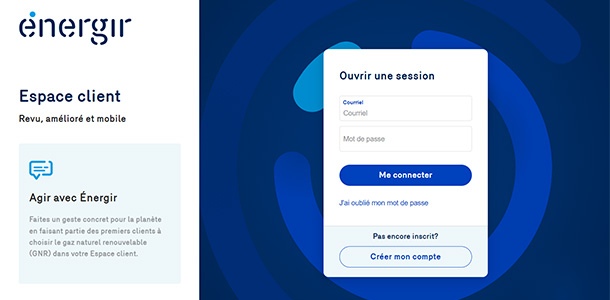
Log in to the Customer space. If you don't have an account, choose the "Create my account" option.
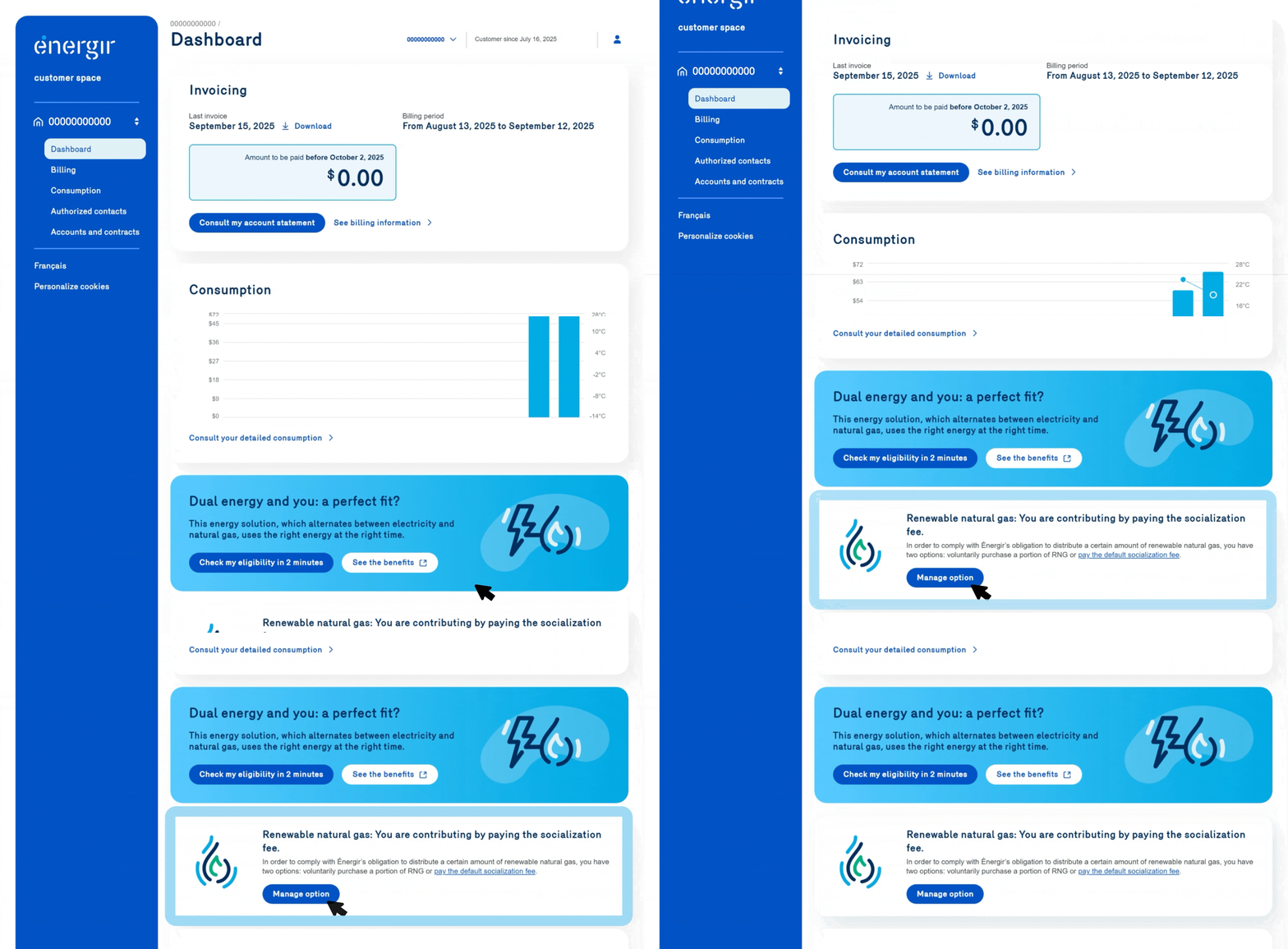
On the home page, click the “Manage Option” button in the Renewable Natural Gas section. If you have multiple accounts, select the desired account first.
Then select the “Voluntary Purchase” option.
Move the cursor to determine the quantity of RNG and compare the effects on your monthly bill and your GHG emissions report.
To find out more about the GHG emissions of RNG and learn about the impact of your voluntary purchase of RNG on Quebec’s GHG emissions and your own GHG emissions, see our frequently asked questions.

Consumption simulation in a test environment; the rate estimate and the potential reduction of fossil‑based CO2 emissions vary depending on the consumption volume at the service address and the applicable RNG price.
Determine the percentage of renewable natural gas you wish to purchase and select the effective date. Then click the “Submit my request” button.
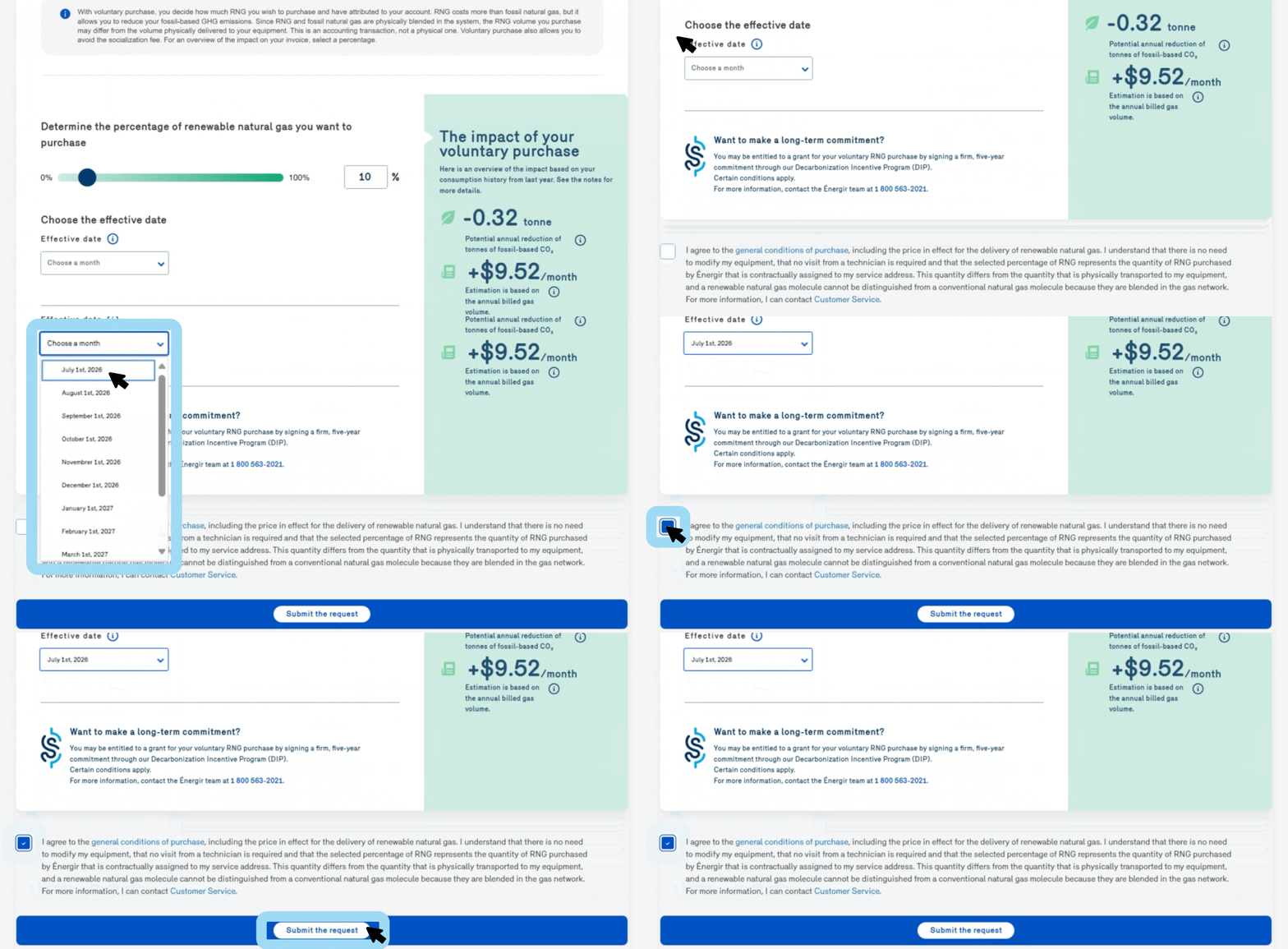
Consumption simulation in a test environment; the rate estimate and the potential reduction of fossil‑based CO2 emissions vary depending on the consumption volume at the service address and the applicable RNG price.

Good to know
You can easily change your percentage at any time, right in your Customer Space.

Get in on the Decarbonization Incentive Program (DIP)
By signing a binding 5-year agreement to purchase at least the amount required to meet the regulatory threshold (i.e., 5% of your gas consumption for Énergir’s 2025 fiscal year), you may be eligible for a grant. Contact us to learn more about the terms and conditions of the program and to sign the agreement.
What does RNG costs?
As of October 1, 2025, the price of RNG is ¢94.884/m3 or $25.04/GJ.
The annual RNG supply rate is set annually as part of the rate case filed each year with Régie de l’énergie.
Énergir’s SPEDE billing rate does not apply to the percentage of RNG purchased.
By voluntarily purchasing percentage of RNG equal to or greater than the regulatory obligation target, you will be exempt from the socialization fees.
To find out more, visit the page Energir | Pricing and Rates.
Customer profiles
Adding RNG to your purchasing profile can be a smart way to improve your business’s GHG balance without having to change your equipment. Compare the effect of different RNG purchase percentages on the bill and on avoided fossil-based GHG emissions.

Small warehouse (1,500 m³)

Offices – 10,000 m³

Elementary school (50,000 m³)

Hospital – 213,000 m³
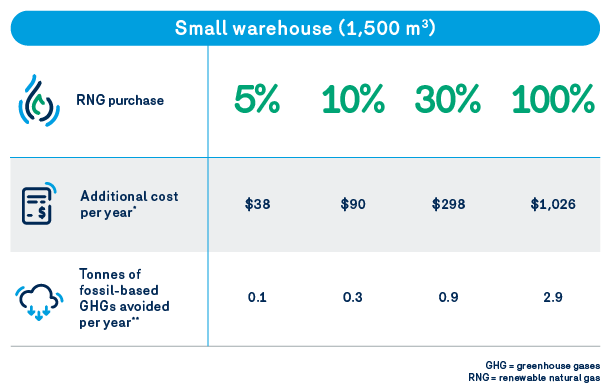
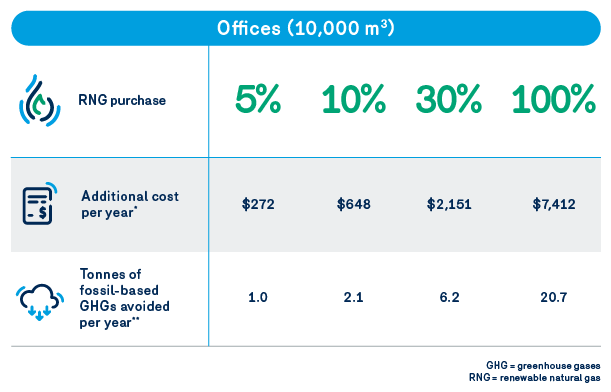
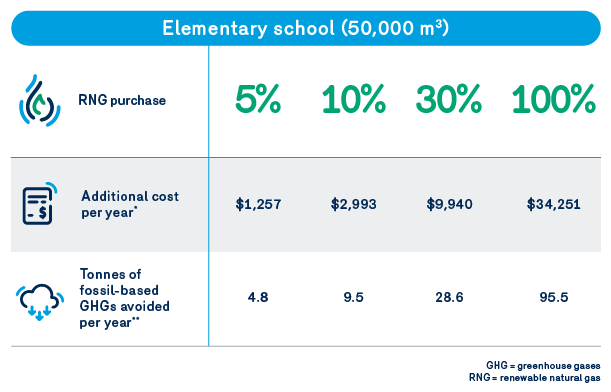
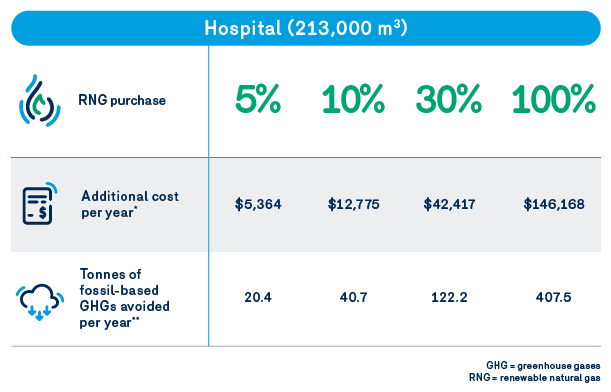
Small warehouse (1,500 m³)
Offices – 10,000 m³
Elementary school (50,000 m³)
Hospital – 213,000 m³
* Natural gas and RNG rates applied in October 2025
** For more information on the methodology used to calculate greenhouse gas (GHG) emissions reduction data, see our methodology page.
Questions?
We've got answers.
Theere is no way to confirm the exact amount of purchased RNG that is delivered to your devices, since RNG and fossil natural gas flow through the same gas network and the molecules are thoroughly mixed together. The same is true for the electricity you purchase: you can’t tell which dam or wind turbine generated the electrons that are lighting your home.
The quantity that is voluntarily purchased by a customer differs from the quantity that is physically transported to the customer’s devices.
Énergir has put stringent measures in place to periodically ensure that its total annual supply from RNG producers to replace fossil natural gas is at least equal to the quantity purchased by all its customers and that the RNG it purchases is 100% organic (and does not include any fossil molecules). After the end of every year, Énergir has its RNG supply and inventory verified by an independent auditing firm. The RNG volumes you purchase are shown on your detailed total natural gas consumption bills.
You can request a change at any time to the amount of renewable natural gas you voluntarily purchase. As a customer, for an effective date of the first of the following month, you must submit your request no later than the 20th of the current month. Requests received after the 20th of the month will be processed with the following month’s requests. The change request is made directly in your Customer Space by specifying the revised purchase percentage and desired effective date.
No modifications to equipment are required since RNG and fossil natural gas are interchangeable. RNG can therefore be used for the same purposes.
To meet regulatory targets for RNG, Énergir sources most of its RNG from producers in the USA. It is working to increase its supply from producers in Quebec.
The quantity of RNG purchased by Énergir from each producer is injected by the latter into the gas network of the region where the producer is located. It can therefore be injected into the gas network of Énergir or another distributor in North America, and then mixed with the fossil natural gas circulating in the same gas network. So, as with its fossil natural gas supply or electricity supply, once the purchased energy is injected into the gas or electricity grid, it is not possible to track the gas molecule or electron. The gas molecule or electron is consumed by the various users connected to these networks.
The quantity of RNG purchased by Énergir reduces the quantity of fossil natural gas that Énergir buys as part of its overall supply.
Since the RNG and fossil natural gas molecules flow through the same gas network and are mixed together indistinguishably, Énergir has a verification body conduct an annual verification to ensure that its total annual supply from RNG producers is at least equal to the quantity of RNG purchased by all its customers and that the RNG purchased is 100% organic (and does not include any fossil molecules).
For more information, see the question “What ensures that the amount of RNG I voluntarily purchased is correctly attributed to my home?”
RNG combustion is not emission-free; it generates GHG emissions (CO2, CH4 and N2O) just like the combustion of fossil natural gas. CO2 is the main GHG that is generated (over 99% of combustion emissions). For RNG, though, the CO2 emissions from its combustion are said to be biogenic because they come from biomass. Biogenic CO2 emissions are not generally targeted by climate change objectives, unlike emissions from the combustion of fossil natural gas. Although CO2 from the combustion of fossil natural gas can be reabsorbed by biomass during photosynthesis, burning fossil natural gas releases CO2 that has been sequestered for millions of years in geological formations and results in a net addition of CO2 to the atmosphere. In contrast, the CO2 released into the atmosphere from RNG combustion (biogenic CO2) was sequestered in organic matter (food waste, manure, wastewater, etc.), which renews much more rapidly, on a scale ranging from a few months to a few years. The biogenic CO2 was present in the atmosphere, was absorbed by organic residues and could be again re-emitted into the atmosphere. Biogenic CO2 is therefore part of the short carbon cycle. The actual effect of biogenic CO2 emissions from RNG combustion on the climate depends on a number of factors, including the biomass source and production processes. RNG sold by Énergir to its customers is produced from organic waste and has not led to significant changes in land use.
Although also biogenic, N2O and CH4 combustion emissions (less than 1% of combustion emissions) from RNG must be reported in the direct emissions (Scope 1 emissions) of the person or entity using RNG in their GHG inventory.
Biogenic CO2 emitted during combustion also has to be quantified. Provided that the applicable rules (including RNG traceability) of the standard used to perform the GHG inventory allow it, biogenic CO2 must be reported separately from Scope 1 emissions in the GHG inventory. The regulations governing the declaration of GHG emissions and Quebec’s GHG cap-and-trade system (CATS) stipulate that these CO2 emissions must be reported but do not have to be covered by emission allowances under Quebec’s GHG cap-and-trade system.
RNG production emits GHGs. GHGs are also emitted during RNG transmission and distribution.
Subject to applicable quantification standards, customers can consider the quantity of voluntarily purchased RNG in their GHG inventory. For more details on how to include GHG emissions from the combustion of voluntarily purchased RNG in a GHG inventory, see the question below: “How are GHG emissions from the combustion of voluntarily purchased RNG accounted for?”.
It is a rate used to distribute the costs associated with the volume of RNG that is required for Énergir to meet its regulatory obligation but that was not voluntarily purchased by its customers. Énergir has a regulatory obligation to distribute a certain minimum quantity of RNG. Even when this entire quantity is not voluntarily purchased by its customers, Énergir is still bound by its obligation. In this case, in accordance with its Conditions of Service and Tariff, Énergir charges the cost of unsold volumes of RNG to customers who, relative to their own natural gas consumption, have not purchased at least the proportion of RNG that corresponds to the regulatory threshold (that is, 2% in 2023-2024, 5% in 2025-2026 and 10% in 2030-2031).


Our commitment for 2030
To meet its regulatory obligation, Énergir must distribute at least 10% renewable natural gas by 2030, which could prevent some 1 million* tonnes of fossil-based GHG emissions.
* For more information on the methodology used to calculate greenhouse gas (GHG) emissions reduction data, see our methodology page.