












Renewable natural gas (RNG) is a renewable energy source and one of the solutions recognized by the Government of Quebec to support the energy transition.1
Since 2019, the Government of Quebec has implemented a regulatory requirement to gradually increase the amount of renewable gas distributed by gas distributors in Quebec, including Énergir.
Énergir also supports RNG regulatory targets. This is one of the four strategic directions in its decarbonization vision.
RNG molecules are interchangeable with fossil natural gas molecules, allowing RNG to replace an equivalent volume of fossil natural gas while using existing infrastructure. RNG also offers several other benefits.
What does the RNG reg requirement provide for?
The Renewable Gas Regulations (CQLR, chapter R-6.01, r. 3.01), passed under the Act respecting the Régie de l’énergie, require Quebec gas distributors to distribute a threshold quantity of gas from renewable sources (GRS) each year, of which RNG is one. This threshold is expressed as a percentage of the total gas volumes distributed annually through Énergir’s network.
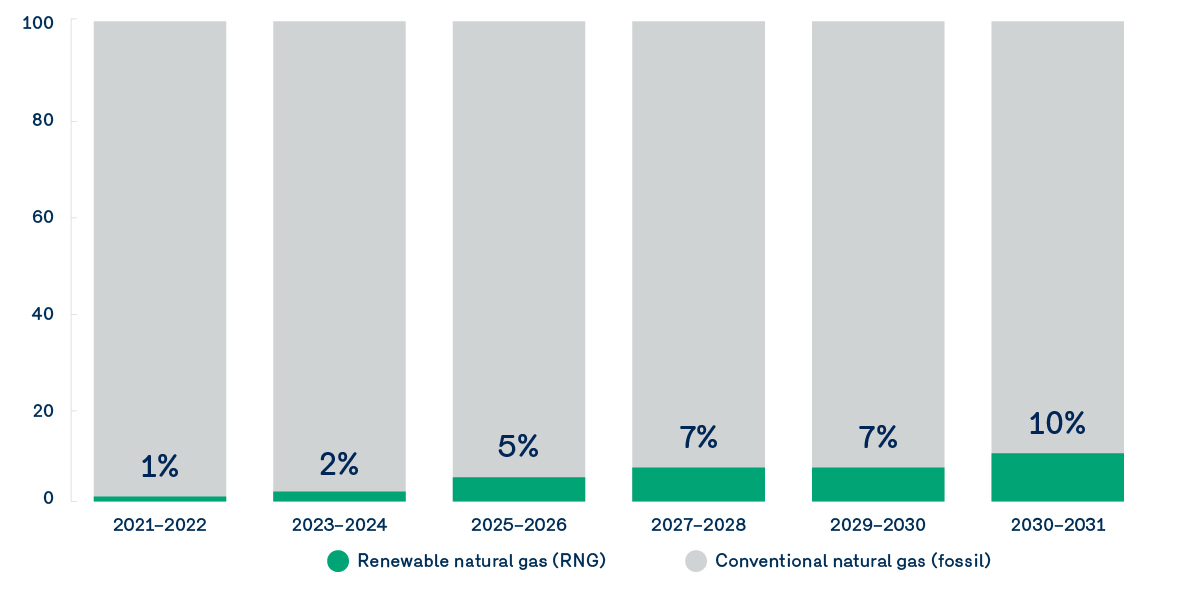
The Government of Quebec has set gradual targets to reach 10% renewable gas by 2030.
Since Énergir’s 2025–2026 rate year, the regulatory threshold in effect has been
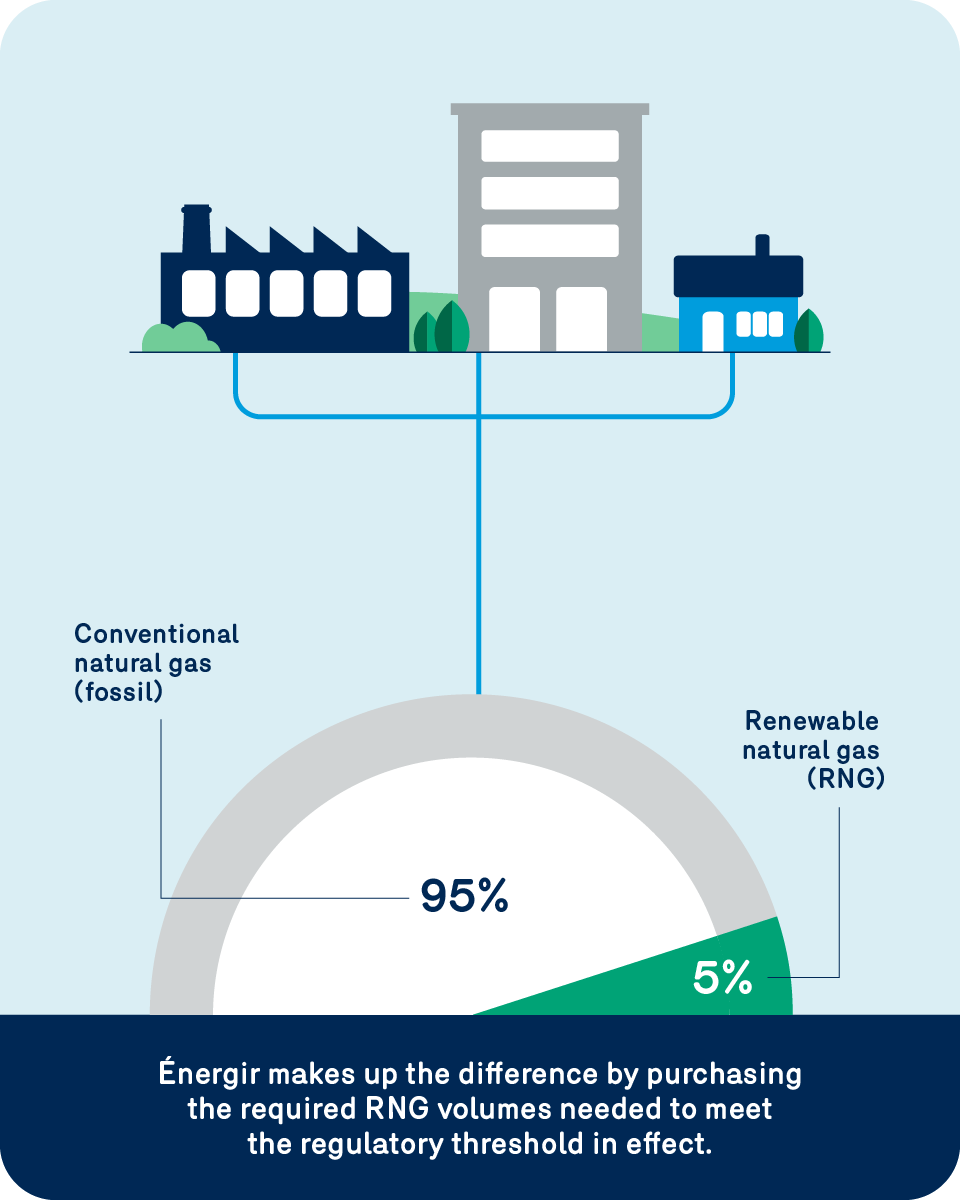
5% of distributed volumes must be RNG
Expected evolution of the regulatory threshold through 2030–2031
How does Énergir ensure compliance with this regulatory requirement?
Natural gas is purchased in an open market where customers can choose their supplier. In addition to its distribution service, Énergir also offers customers a gas supply purchasing service for both natural gas and RNG.
Subject to the requirements related to their connection and to the applicable Conditions of Service and Tariff, Énergir customers may choose whether or not to voluntarily purchase RNG.
However, when RNG purchases by customers served by Énergir are not sufficient to meet the regulatory threshold in effect, Énergir must still ensure compliance with it.
Énergir therefore acquires the RNG volumes needed to meet its regulatory requirement, replacing equivalent volumes of fossil natural gas.
Why do socialization fees appear on my bill?
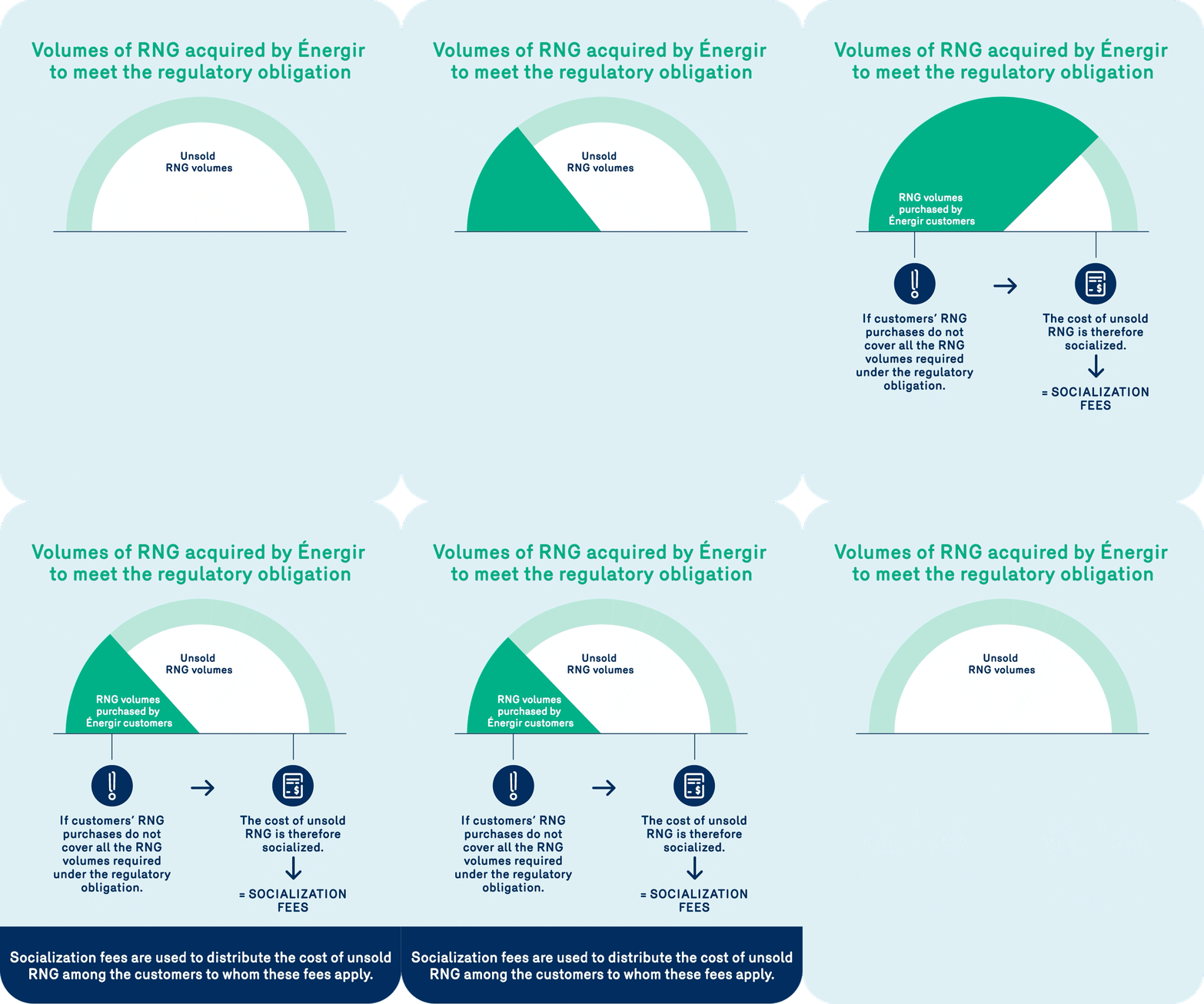
When the RNG volumes billed in response to customer purchase requests do not cover the volumes required to meet the regulatory threshold, a mechanism approved by the Régie de l’énergie allows Énergir to distribute the additional cost of unsold volumes across the bills of customers subject to the requirement, in accordance with the Conditions of Service and Tariff document. This is known as socialization fees.
These fees apply to distributed volumes of fossil natural gas supply. Therefore, each cubic metre purchased as renewable natural gas supply is excluded from these socialization fees.
In addition, customers can reduce the socialization fee rate applied to their bill by ensuring they purchase at least the equivalent of the regulatory threshold in effect — 5% in 2026–2027 — as RNG supply
Frequently asked questions about RNG
Socialization fees are to distribute the costs associated with the volume of RNG required for Énergir to meet its regulatory obligation but that was not voluntarily purchased by customers. Énergir has a regulatory obligation to distribute a certain minimum quantity of RNG. Even when this entire quantity is not voluntarily purchased by its customers, Énergir is still bound by its obligation. In such cases, Énergir’s Terms of Service and Rates call for unsold RNG volumes to be charged to customers who did not purchase at least the regulatory threshold amount (that is, 2% in 2023–2024, 5% in 2025–2026 and 10% in 2032–2033) for their own natural gas consumption.
Because Énergir must meet a regulatory obligation to distribute RNG, even when the required volumes are not entirely purchased voluntarily by customers.
No. Énergir makes no profit from distributing natural gas, whether it be fossil or renewable. Socialization fees are meant to recover actual costs incurred in meeting the regulatory obligation.
The answer depends on your consumption profile, decarbonization goals and financial situation. For many clients, purchasing RNG up to the regulatory threshold amount represents an overall cost comparable to just paying the socialization fee.
Yes. The sales team or the person in charge of your account at Énergir can help you understand the impact on your particular situation and assess your available options.
Contact us to find out more.
To meet the regulatory RNG targets, Énergir sources RNG primarily from producers located in the United States. It is working to increase its supply from producers in Quebec. The amount of RNG Énergir purchases from each producer is injected by the producer into the gas distribution system in the region where the producer is located. It can be injected into Énergir gas distribution system or that of it is another distributor in North America and it is then blended with the fossil natural gas flowing through the same distribution system. As a result, RNG and fossil natural gas are indistinguishable. So as is the case with Énergir’s supply of fossil natural gas or the supply of electricity, once the purchased energy is injected into the gas distribution system or the power system, the gas molecule or electron cannot be tracked. The gas molecule or electron is consumed by the different users connected to these systems.
The amount of RNG Énergir purchaces reduces the quantity of fossil natural gas that Énergir purchases as part of its overall supply. Énergir has a verification body conduct an annual verification to ensure that its total annual supply from RNG producers is at least equal to the quantity of RNG purchased by all its customers and that the RNG purchased is 100% organic (and does not include any fossil molecules).
There is no way to confirm the exact amount of purchased RNG that is delivered to your devices, since RNG and fossil natural gas flow through the same gas network and the molecules are thoroughly mixed together. The same is true for the electricity you purchase: you can’t tell which dam or wind turbine generated the electrons that are lighting your home.
The quantity that is voluntarily purchased by a customer differs from the quantity that is physically transported to the customer’s devices.
Énergir has put stringent measures in place to periodically ensure that its total annual supply from RNG producers to replace fossil natural gas is at least equal to the quantity purchased by all its customers and that the RNG it purchases is 100% organic (and does not include any fossil molecules). After the end of every year, Énergir has its RNG supply and inventory verified by an independent auditing firm. The RNG volumes you purchase are shown on your detailed total natural gas consumption bills.
Legal notices
1.The 2026–2050 Integrated Energy Resource Management Plan (IERMP) developed by the Government of Quebec in collaboration with Hydro-Québec and natural gas distributors establishes a common framework for planning energy management through 2050. Bioenergy and renewable gas, including renewable natural gas (RNG), are important components of the IERMP. The plan notes that these solutions will generate more renewable energy locally, leverage local resources and bolster regional economic development.
2. In accordance with the Conditions of Service and Tariff in effect, socialization fees may be avoided if the RNG supply purchase and the historical renewable natural gas purchase volume associated with this service connection have exceeded the regulatory threshold continuously since October 1, 2025.